
Commodity price volatility has become a structural feature of the global economy, driven by geopolitical tensions, climate shocks and rising demand for critical inputs. To stay competitive and protect continuity, businesses need to rethink their sourcing, supply chain design and risk management strategies.
Geopolitics: Disruption is the new normal
Geopolitical instability is reshaping global commodity flows. Armed conflict is a major disruptor, capable of pushing commodity prices higher almost immediately. The US/Israel-Iran war, which began in February 2026, has severely affected oil supplies from GCC countries.
In 2025, GCC countries accounted for 29% of global oil exports, and the immediate blockage of their primary export route, the Strait of Hormuz, triggered a 30% increase in oil prices between February and March 2026.
Source: Euromonitor International
Similarly, commodities were also affected by other military geopolitical events in the past. The war in Ukraine drove food prices up by 23% in early 2022. Sudan's 2023 civil war disrupted critical gum arabic exports, while Venezuela's 2026 regime shift moved oil markets primarily through sentiment and expectations of future capacity rather than immediate supply loss, prompting companies to reassess long-term sourcing strategies amid evolving geopolitical dynamics.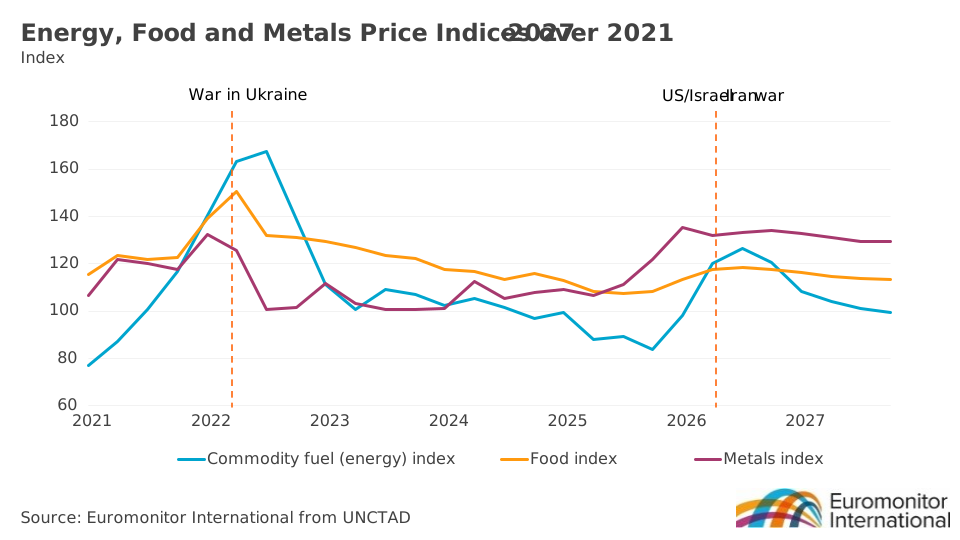
Resource nationalism is redrawing commodity supply maps. Indonesia’s tighter nickel export rules and China’s rare earth export controls have led global companies to speed up recycling, invest in alternative refining capacity and redesign products to reduce dependency. For example, Apple and Tesla have both increased rare earth recycling and sought non-Chinese suppliers.
Climate change: Agricultural volatility intensifies
Climate change is destabilising agricultural production through extreme weather, heatwaves and unstable rainfall. The impact is amplified by geographic concentration: over 60% of cocoa comes from Côte d'Ivoire and Ghana, while Brazil and Vietnam dominate coffee. In Q2 2024, cocoa prices rose by 183% year-on-year after climate shocks in West Africa; coffee prices jumped 88% year-on-year following droughts in Brazil and Vietnam in early 2025.
Fragmented production increases vulnerability, as smallholder farmers often lack resources for climate adaptation. Companies with integrated supply chains, such as Tyson Foods and Dole Food, are better positioned to manage risks, while Nestlé, Mars and Unilever invest in farmer support programmes and climate-resilient practices. Other manufacturers are reformulating products to reduce reliance on volatile inputs. For example, Nestlé has increased robusta content in coffee blends.
Technology and energy: The AI revolution drives demand
The rapid expansion of AI, data centres and automation is driving unprecedented demand for electricity and critical metals such as copper, aluminium, lithium and rare earths. This demand is colliding with uneven energy strategies and geopolitical constraints, amplifying price volatility and widening competitive gaps.
Electricity costs are now a key factor in choosing AI infrastructure locations. In 2025, industrial electricity prices in Europe were more than double those in the US and China, reflecting reliance on imported gas and regulatory charges. Governments are responding: the US is extending nuclear plant lifetimes, China is expanding capacity across all sources, and France and Sweden are investing in nuclear reactors.
Production of critical metals is highly concentrated. China controls 63% of rare earth oxides, Australia and Chile lead in lithium, and the Democratic Republic of Congo supplies 71% of cobalt.
To reduce supply risks, companies such as Albemarle (US) are expanding domestic lithium production, while Microsoft (US) has secured a 20-year nuclear power agreement to guarantee reliable, carbon-free energy for its data centres.
Building resilience: Strategic actions for the future
Volatility will remain the norm. Business leaders should integrate geopolitical risk pricing and hedging into contracts and inventory policies, diversify sourcing and invest in circular supply chains. Securing reliable baseload power and optimising procurement will be vital as digital demand grows. In agriculture, diversified sourcing, farmer support and recipe reformulation will help maintain continuity amid climate shocks. Logistics networks must include alternative routes and strategic buffers to bypass chokepoints.
Explore more in our full report, Navigating Commodity Market Risks and Volatility.
This content was produced with the assistance of AI. All information is original to Euromonitor and comes from our report, Navigating Commodity Market Risks and Volatility. The final article has been reviewed by our team to ensure the highest standards of quality and integrity.