
The US/Israel-Iran war has caused a major shift in global economic dynamics, driving oil prices higher and exposing vulnerabilities in energy-dependent economies. With the Strait of Hormuz – responsible for over a quarter of global oil exports – blocked, inflation and supply chain disruptions are spreading far beyond the Gulf. This crisis is deepening the divide between energy importers and exporters, prompting businesses and governments to reconsider resilience, competitiveness and long-term growth strategies.
The Strait of Hormuz blockage has halted the main route for GCC countries, responsible for 28% of global oil and 11% of natural gas exports, raising oil prices by 30% over February-March 2026
Source: Euromonitor International
Global growth slows as inflation rises
The immediate economic impact is clear. Euromonitor International has lowered its 2026 global GDP growth forecast to 2.9%, down from 3.1% before the war. Surging energy costs are reducing activity and undermining business confidence. Inflation is forecast to reach 4.7% in 2026, up from 3.6% forecast before the war, with the highest increases in developing markets where weaker currencies and energy-intensive production amplify the shock.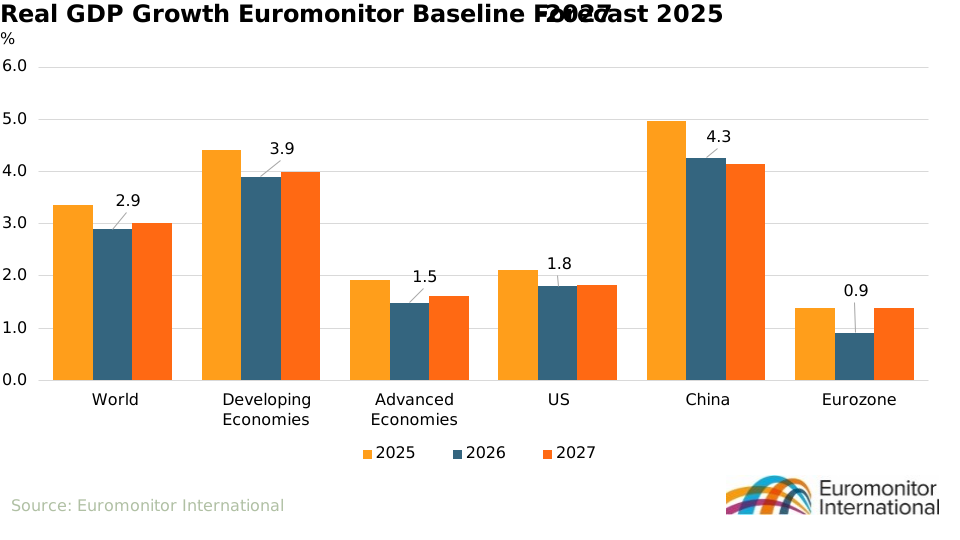
The impact extends beyond energy. Higher freight and insurance costs, disrupted fertiliser supplies, and reduced Gulf tourism are driving up costs across food, manufacturing and logistics. For businesses, this is a broad-based cost shock, squeezing margins and challenging established supply chains.
GCC economies: Resilience under pressure, growth downgraded
Gulf Cooperation Council (GCC) economies are at the centre of the disruption. Regional GDP growth is now forecast at just 2.1% in 2026, a downgrade of 2.3 percentage points from pre-war expectations. While Saudi Arabia and the United Arab Emirates have activated alternative export routes – such as the East-West pipeline to the Red Sea and increased loadings through Fujairah – these steps only partly offset the loss of Hormuz capacity.
Beyond energy, the GCC’s position as a tourism, aviation and logistics hub has been severely affected by cancelled flights, rerouted shipping, and higher freight costs. The global knock-on effects include disruptions to petrochemicals and fertilisers, impacting food and industrial supply chains worldwide.
Most exposed: Energy importers and export-led manufacturers
The war has highlighted the vulnerabilities of economies heavily reliant on imported energy and export-orientated manufacturing. Japan is highly exposed because it imports most of its crude oil and natural gas (largely from the GCC), so higher prices and shipping disruption are expected to slow GDP growth to about 0.6% in 2026. South Korea faces similar energy-import dependence (42% sourced from the Gulf and Iraq) and, with manufacturing making nearly one third of GDP, is being hit by higher input costs and supply-chain bottlenecks including helium shortages for semiconductors. Germany is struggling with renewed energy inflation and weak external demand, which is delaying its already fragile industrial recovery.
Most resilient: Energy security and domestic demand
In contrast, economies with secure energy sources, strong domestic demand and diversified supply chains are coping more effectively. A net energy exporter US is relatively insulated. Despite a growth projection downgrade, US growth is forecast at 2.1% in 2026, supported by robust domestic demand and deep financial markets.
India, despite being a net oil importer, benefits from a large internal market and diversified sourcing, which cushions the impact of higher prices. Mexico’s partial oil revenues and close integration with the US provide stability, while Spain’s high renewables share and LNG infrastructure reduce its reliance on Middle East energy flows.
Building resilience: Strategic priorities for business
Looking ahead, the duration of the war is the key factor for global growth. Euromonitor’s baseline scenario assumes the war is contained within months, but a prolonged war could push global growth down to 2.7% in 2026. Persistent volatility now defines the risk landscape, with energy shocks likely to become a structural feature of global markets.
Businesses must integrate geopolitical risk into pricing, contracts and inventory policies, and diversify supply chains and energy sources. Strategic investment in renewables, energy efficiency and multi-route logistics will be central to future competitiveness. Resilience is now a core driver of long-term growth.
Discover more in our latest full report, US/Israel-Iran War: GCC Impact and Diverging Economic Exposure.