Food and NutritionConsumers are engaging with food and nutrition like never before. Our in-depth analysis examines the most important implications across the industry, providing market intelligence, original thinking and key insights.
As consumers become more selective, claims made about food are now less about driving incremental value and more about maintaining relevance. A clearer “claim ladder” is emerging: baseline nutrition cues at the bottom, and outcome-led propositions at the top that can still justify premium pricing when aligned with category role and sensory appeal.
This reflects a tougher growth environment. Food growth has moved from volume to value, shaped by high prices, smaller consumption occasions and rising scrutiny of ultra‑processed foods. In 2025, global packaged food volumes grew at just a 0.6% CAGR, increasing reliance on price and mix for profit.
46% of consumers globally prioritise low price, the most popular product feature ahead of health and nutrition
Source: (Euromonitor Voice of the Consumer: Lifestyles Survey, fielded February 2026, n=40,337)
The Iran war adds further uncertainty around energy, freight and commodity costs, pressurising purchasing power and sharpening tradeIn this context, brands need to focus less on adding claims, and more on which claims deliver value.
Eroding pricing power
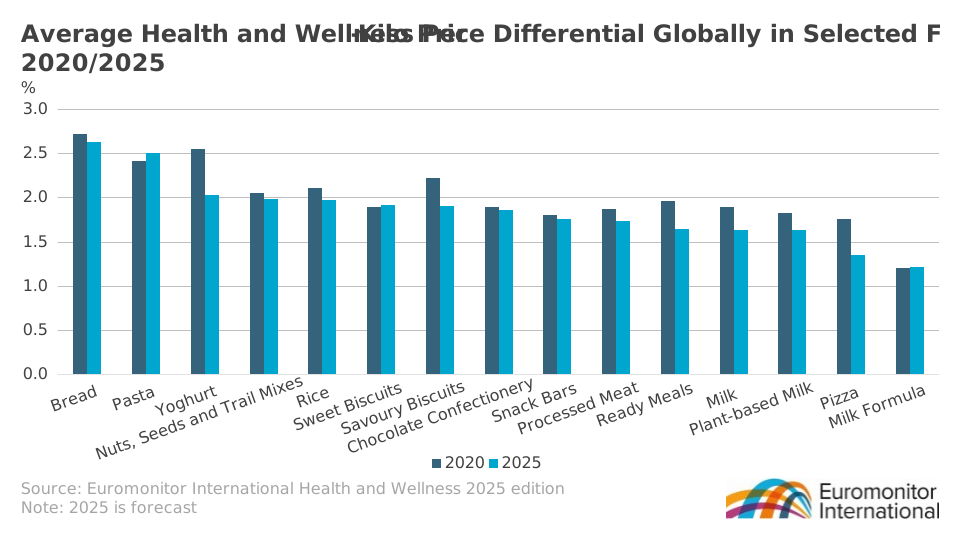
Wellness-positioned products still command premiums in many markets, but these have eroded over time and vary by category. In staples such as bread, pasta, rice and milk, healthier variants still carry a premium, but the gap is narrowing as wellness becomes mainstream and consumer trade‑offs sharpen.
Snacks stand out as an exception. In biscuits, chocolate and bars, health-positioned products continue to show stronger price growth and wider dispersion. Consumers are more willing to pay when indulgence is paired with benefits perceived as additive rather than corrective. Value now concentrates around claims that signal clear purpose, specificity and credible benefit.
Rung 1: Baseline claims
Many once-differentiating claims have become non-negotiable, baseline expectations. Gluten free is increasingly expected across categories. No added sugar has followed a similar trajectory, particularly in dairy. High protein remains relevant, supported by fitness and satiety trends, but its ability to sustain premiums has weakened as penetration increases.
These claims still matter commercially. They protect relevance and reduce perceived risk, but pricing power is declining due to standardisation, rising penetration and private label expansion. Retailers are scaling affordable wellness ranges, accelerating the shift of baseline claims into everyday expectations and compressing mid-tier pricing.
Rung 2: The value bridge
Between baseline and premium sits a critical middle tier: claims that remain accessible, scalable and genuinely value-adding. The opportunity is not to stack multiple claims, but to be selective; choosing propositions that align with category role and occasion and communicating them clearly. The UK dried pasta market shows how high protein alone can quickly hit a ceiling, with private label squeezing price per gram and forcing brands to pivot towards different formats, ingredients and culinary narratives.
This is also where affordable wellness can be rebuilt, especially in staples. Inherent nutrition, simplicity and clean reformulation are becoming more important than heavy fortification, particularly as regulatory scrutiny tightens and cost pressures persist. Done well, this rung allows brands to balance margin protection with affordability.
Rung 3: Benefit-led claims
Premium wellness has narrowed but remains viable. Pricing power is increasingly concentrated in claims tied to specific outcomes, such as digestive health, immune support, cognitive performance, omega‑3 and metabolic health. In sweet biscuits, emerging GLP‑1‑linked and blood‑sugar narratives illustrate how metabolic positioning can stretch pricing, as seen in premium fibre‑led US cookie launches such as ChipMonk, which command USD3-3.5 per cookie.
Such claims are more resilient because they convey physiological relevance rather than generic “better for you” positioning. However, they require discipline. Strong propositions combine inherent nutrition, targeted functionality and clear occasion relevance. Over‑claiming risks eroding trust as consumers become more sceptical and price‑sensitive.
Strategic implications
The claim ladder is a strategic tool for portfolio and category management. In staples, where demand is stable and price elasticity limited, value creation depends on affordable wellness built on simplicity and trust. In discretionary categories such as sweet snacks, brands can still drive premiumisation through fewer, higher‑quality choices with credible, benefit‑led positioning.
In a market defined by constrained consumption, geopolitical shocks and ongoing cost pressure, success will come from treating claims as a structured ladder; moving up only when category dynamics and willingness to pay support it.
Closing thought
Wellness claims remain effective, but their role is more stratified. Baseline claims protect relevance but no longer guarantee pricing power. Benefit‑led claims can still command premiums when credible. The middle rung offers the greatest opportunity to scale affordable wellness without unnecessary complexity.
The key shift is from asking “Which claims should we add?” to “Which rung are we competing on?”, and ensuring product, pricing and proposition align.
Our Voice of the Consumer data helps you identify evolving trends and understand the impacts on consumer eating choices. Gain valuable insights about consumer…
Asian cuisine outpaced the wider restaurant industry over 2020-2025, with nearly two in five non-ambient ready meals now Asian dishes. This report unpacks the…
Energy management is reshaping coffee consumption as consumers seek more control over caffeine, focus and wellbeing across the day. Coffee risks losing key…