
The global energy price shock and supply disruptions amid the US/Israel-Iran war expose Asia’s dependence on Middle Eastern energy, concentrated trade corridors, and highly price-sensitive consumer demand. The immediate disruption is already affecting economies, companies and consumers across the region, but the bigger implication is more structural: energy security, supply chain optionality, and value-driven demand are becoming more central to business strategy in a more volatile operating environment.
Asia the most exposed to disruption in the Gulf
Many economies across Asia are net energy importers. While the US and Europe have more diversified sources of supply, Asia relies heavily on imports via the Strait of Hormuz. Per the US Energy Information Administration, in 2024, 84% of crude oil and condensate and 83% of LNG moving through the strait went to Asian markets. In 2025, countries in the Middle East supplied 36% of South Korea’s energy imports, 27% of China’s, and 26% of Japan’s.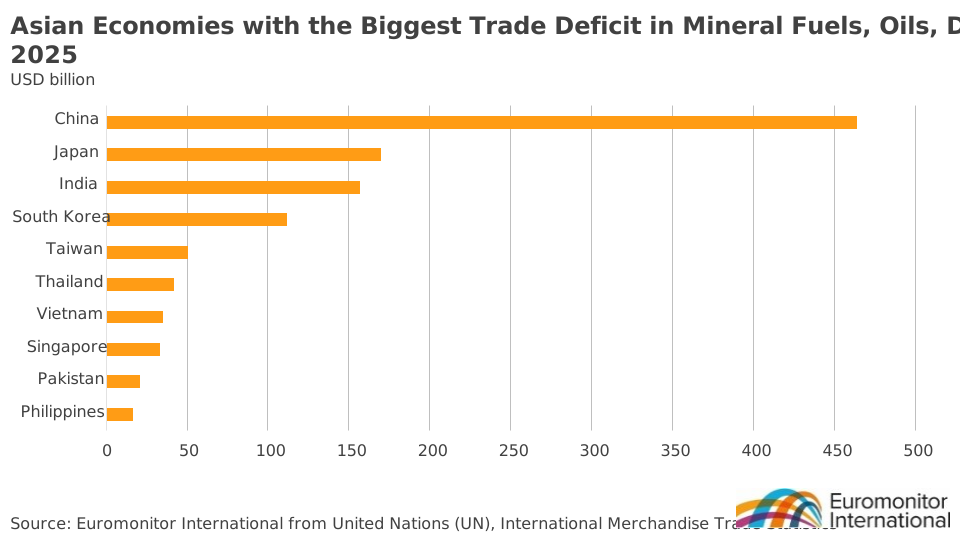
Asia’s exposure and impact not uniform
In emerging and developing Asia, energy demand per capita is generally lower, and governments struggle to cushion higher fuel/power costs. The impact: long fuel queues, school closures, 4-day work weeks, fuel rationing, and other emergency measures. Subsidies and price controls can soften the impact, but policy room remains limited.
In 2025, final energy consumption per capita was 0.2 tonnes of oil equivalent in Bangladesh, compared with 3.2 tonnes in South Korea
Source: Euromonitor International from International Energy Agency
In developed Asia, the shock is apparent more as margin squeeze and rising industrial energy costs. Japan, South Korea, and Taiwan have the strategic reserves and policy levers to soften the impact on households. However, their acute exposure, especially to imported LNG, means manufacturers and energy-intensive sectors (eg electronics, semiconductors) are vulnerable to sustained cost pressure. In South Korea and Taiwan, chip production depends not only on reliable power, but also on inputs linked to gas processing and oil refining, including helium and sulphur-derived chemicals.
The disruption also affects fertiliser flows. Higher fertiliser costs or reduced availability pressure food systems across Asia, especially in import-dependent markets and large agricultural economies (eg India). Economies with low food self-sufficiency, including Japan, South Korea, Singapore, and Hong Kong, are especially exposed to knock-on price pressure.
For companies, the shock is likely to impact their demand and costs. In markets with high imports of food, fertilisers and energy, household budgets will face greater strain, weakening discretionary spending, and businesses face rising input, freight and utility costs that feed through supply chains faster than pricing can adjust. The result is a double squeeze of softer demand and tighter margins across much of Asia.
From cost optimisation to diversification, nearshoring and ally-shoring
For decades, companies operating in Asia optimised for cost, scale, and efficiency. This disruption is a reminder that resilience, flexibility, and speed of response are equally critical. Previous shocks and crises taught that businesses diversifying faster recover faster.
Because this shock is feeding through fuel, transport, utilities, and food simultaneously, consumers across much of Asia are becoming more price-sensitive, accelerating downtrading in FMCG and foodservice and reducing discretionary spend. At the same time, disruptions to the Strait of Hormuz are not just raising energy costs – they are increasing shipping costs, extending lead times and reducing reliability across Asia-Europe trade. For export-orientated economies, eg Vietnam, Thailand, Malaysia, this affects both production continuity and competitiveness.
Companies operating in the region must move beyond cost optimisation towards diversification across energy sources, suppliers, production locations, and logistics routes. This includes investing in diversified energy sources, expanding renewables where viable to strengthen domestic energy resilience, and redesigning supply chains through regionalisation, nearshoring and ally-shoring where concentration risk is highest.
The more strategic question for Asia is not only how to respond to this shock, but how to compete in a region where energy security is less certain, trade routes are less reliable, and consumers are becoming even more value-driven. Growth opportunities remain, but are likely to become more uneven and more dependent on strategic flexibility and supply chain resilience.