
The global economy remains resilient despite the uncertain trade environment. Easing inflation, more accommodative monetary policy and sustained investment in technology, particularly AI, continue to provide support. Still, despite the US Supreme Court’s ruling on 20 February invalidating Trump’s “reciprocal” tariffs, trade uncertainty and geopolitical risks continue to weigh on consumer and business sentiment. According to Euromonitor International’s baseline scenario, global real GDP growth is projected at 3.1% in 2026, slightly below 3.2% in 2025, as tariff effects and policy uncertainty dampen near-term activity.
Although trade tensions moderated following the Supreme Court’s ruling and the subsequent application of a 10% global tariff, uncertainty persists given the US administration’s continued use of tariffs as a policy tool. Additional downside risks stem from geopolitical fragmentation, climate-related disruptions and the potential correction of AI-driven investment valuations.
Advanced economies remain resilient, but growth momentum stays constrained
Advanced economies are expected to grow by 1.6% in 2026, broadly in line with 2025, supported by easing inflation and tight labour markets. Supply chain adaptability, resilient services activity and targeted public spending have underpinned performance. However, elevated tariffs, subdued external demand and policy uncertainty continue to limit private investment and export growth.
The US economy is projected to maintain a similar pace in 2026, driven by resilient household consumption and AI-related capital expenditure. While inflation has moderated, high services prices and ongoing tariff effects (now under temporary Section 122 authority) continue to weigh on affordability and sentiment. Trade uncertainty and restrictive financial conditions constrain private investment, with public spending on infrastructure, energy and defence acting as a stabiliser rather than a new engine of growth.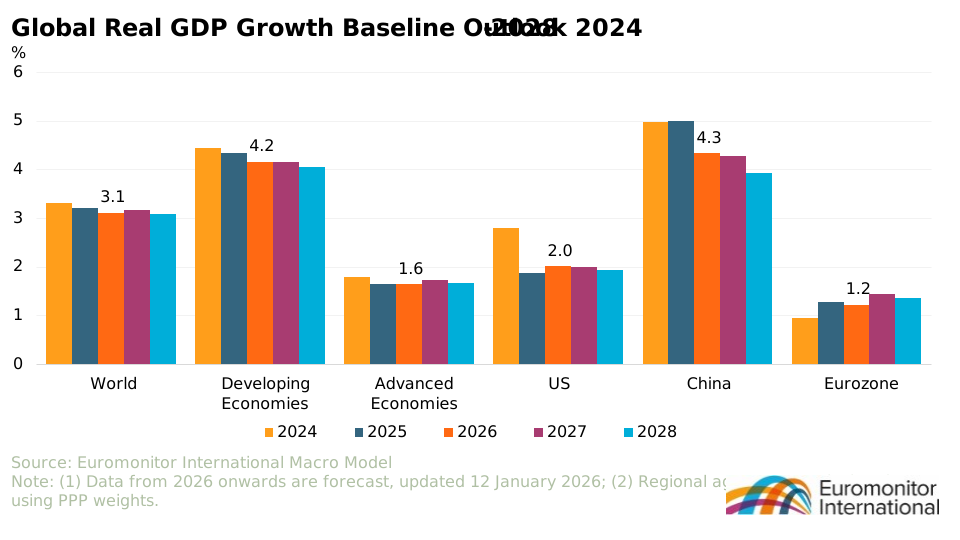
The Eurozone’s recovery remains modest in 2026, supported by household consumption and increased public spending, particularly in defence and infrastructure. Services-orientated economies are set to outperform, while manufacturing-heavy and export-dependent countries continue to lag. Although inflation has stabilised near the ECB’s 2% target, weak private investment, soft external demand and exposure to US tariff risks are expected to keep growth subdued at around 1.2%.
Developing markets lead global growth, but trade and geopolitical risks persist
Developing markets remain the primary engines of global expansion, with growth projected at 4.2% in 2026, slightly slower than in 2025. Domestic demand, public investment and expanding services sectors, particularly across Asia, underpin resilience. However, trade barriers, geopolitical tensions and commodity price volatility continue to pose risks.
China’s growth is forecast to moderate to around 4.3% in 2026 following stronger-than-expected performance in 2025. Weak consumption, ongoing property sector adjustment and softer external demand weigh on activity.
Source: Euromonitor International
While targeted stimulus and strategic investment in technology and green industries offer support, deflationary pressures persist amid excess capacity and fragile household confidence.
India is expected to remain the fastest-growing major economy, expanding by around 7% in 2026. Growth is driven by resilient private consumption and sustained public investment, supported by easing inflation and accommodative monetary policy. Nonetheless, exposure to commodity price swings and global trade uncertainty presents risks to exports and corporate margins.
Global inflation continues to ease, though divergence across economies remains
Global inflation continues to ease but remains uneven. Consumer price inflation is expected to decline to 3.5% in 2026 from 4.0% in 2025, reflecting softer demand, lower energy prices and moderating goods inflation. Disinflation should support real incomes, though progress varies across economies.
In advanced markets, inflation is projected to average 2.3% in 2026, gradually converging towards central bank targets. The US continues to face higher inflation than its peers due to tariff effects and persistent services price pressures, particularly in housing and healthcare. In contrast, Eurozone inflation has stabilised near to 2%, supported by lower energy costs and easing supply constraints.
China remains an outlier, with inflation subdued at 0.6% as weak domestic demand and overcapacity sustain deflationary forces. India faces upward pressure from food prices, though overall inflation is expected to remain within the central bank’s target range.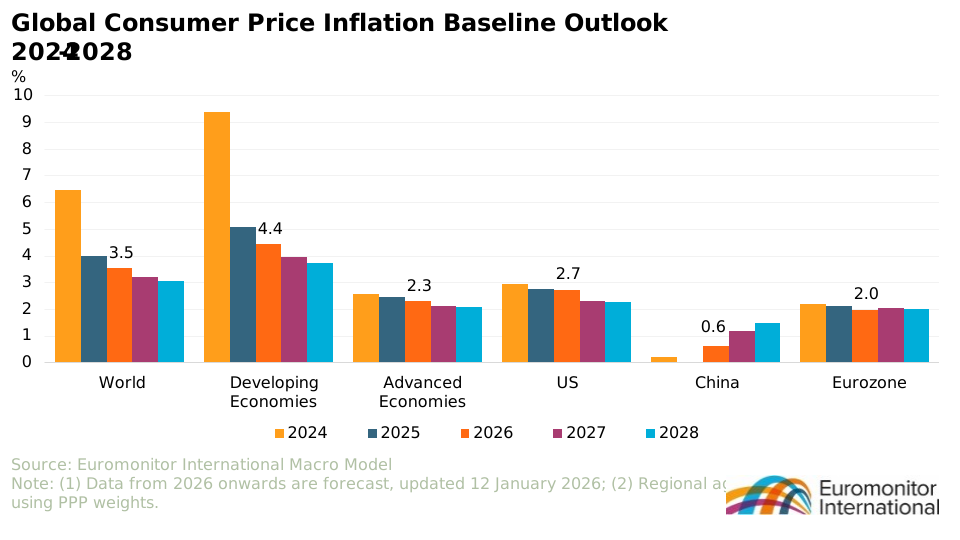
While easing trade tensions and moderating demand should help stabilise price pressures in 2026, upside inflation risks persist. Climate-related disruptions, geopolitical escalation and renewed commodity price shocks could reverse recent disinflation trends. Over the medium to long term, rising trade protectionism and ongoing supply chain reconfiguration may structurally lift production costs and consumer prices.
For more insights on the evolving global economic outlook, explore the full Euromonitor International Global Economic Forecasts Q1 2026 report.