
The US Supreme Court’s landmark ruling on 20 February 2026 found that President Trump’s use of emergency powers to impose tariffs was unlawful. Far from reducing trade policy volatility, the Court’s decision – and the White House’s immediate pivot to alternative tariff tools – have increased uncertainty for trading partners, companies and consumers. Understanding the implications of this shift and its consequences is crucial for stakeholders to adapt strategically and make informed decisions.
Tariffs are here to stay – and keep changing shape
All “reciprocal” and “fentanyl” tariffs based on the International Emergency Economic Powers Act (IEEPA) were invalidated by the US Supreme Court.
Within hours of the ruling, President Trump imposed a blanket 10% ad valorem duty on virtually all imports under Section 122 of the Trade Act of 1974 for 150 days. The White House has also indicated it is working towards a 15% rate – the maximum allowed under Section 122.
Meanwhile, sector-specific duties remain in place under Section 232, including 50% on steel, aluminium, and copper, 25% on motor vehicles and parts, and 25% on microchips. For many products, these tariffs apply on top of the new temporary Section 122 duty. The core tariff regime under Section 301 targeting China also remains largely in place.
The most exposed industries are food and beverages, apparel and footwear, automotive and industrial goods, and electrical goods
Source: Euromonitor International
The White House’s use of alternative tariff tools has amplified volatility and uncertainty, leaving trading partners and companies to navigate a more complex and unpredictable trade environment.
It’s harder to plan with a countdown clock
Many export-dependent Asian countries that had negotiated higher “reciprocal” rates, such as Vietnam (20%), Thailand (19%), and Malaysia (also 19%), now benefit from the lower 10% tariff through to 24 July. These countries, whose main exports include apparel, footwear, home and garden products, are likely to accelerate shipments, rebuild US inventories, and lock in orders while the lower 10% tariff is available. This “pull forward” strategy, however, ties up working capital, strains logistics and warehouse capacity, and may lead to a dip in demand later in the year if tariffs rise again and purchases have been brought forward.
By contrast, Japan, South Korea and the EU have less room to benefit from the 10% flat rate because their US exposure is concentrated in categories such as autos, machinery and metals where duties are significantly higher. That shifts the adjustment burden from timing to structure, forcing tougher pricing choices and accelerating efforts to localise North American manufacturing or redesign products where possible to reduce tariff-exposed content.
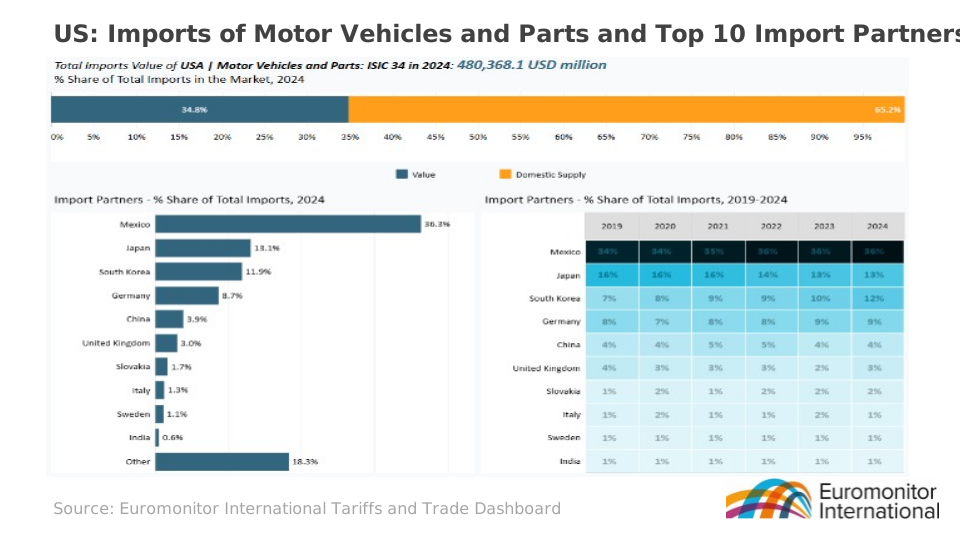
In the US, meanwhile, import-reliant retailers and manufacturers face unpredictable total delivered costs and lead times, pushing them into defensive tactics such as shorter contracts, higher inventory buffers, and delayed or paused investments. The 150-day limit creates a countdown clock, making it harder to commit to multi-year pricing, sourcing and capacity plans.
Navigating an increasingly uncertain environment
The Supreme Court has constrained one legal route, not the political appetite for tariffs. Euromonitor's Voice of the Industry Survey, fielded in March 2025 (n=236) and October 2025 (n=199), shows that 72% of companies expect changes in global trade tariffs to have a moderate or extensive impact on their business in 2026. In this environment, the priority is to shift away from reactive measures to structural flexibility that mitigates long-term tariff risks:
- Diversify supply chains and build resilience by strengthening regional operations to move faster, reduce dependence on any single country, and enable shifts in production when needed.
- Reduce exposure where redesign is feasible by designing products for material and component flexibility, so inputs can be switched readily if tariffs shift. Adjusting materials, components or configuration can sometimes move a product into a different customs classification or reduce the tariff-exposed portion of the product. This approach, often referred to as “tariff engineering”, has become a strategic lever when tariffs are volatile.
- Deepen consumer understanding to protect demand. Tariffs reach consumers through higher prices, fewer promotions, and narrower choice, which can change consumer behaviour. Track where shoppers are most likely to trade down, switch brands, delay purchases, or move to lower-priced channels, and reflect that in pricing, promotion and assortment decisions.
- Build optionality beyond the US by treating export diversification as an imperative. Euromonitor’s Alternative Market Index assesses demand orientation, import reliance, purchasing power and market scale to highlight destinations such as Mexico, Poland and the United Arab Emirates as attractive options for many exporters. The most resilient export strategies position high-performing markets as regional gateways rather than isolated destinations. Mexico anchors North American supply chains, Poland connects exporters to the wider EU single market, and the United Arab Emirates facilitates re-export flows across Middle East and Africa, enabling scalable diversification beyond domestic demand alone.
After all, tariffs are only one side of the story. Non-tariff barriers such as import quotas, licensing restrictions, or administrative hurdles can also tighten trade without relying on tariffs, reinforcing the case for structural flexibility and diversification.