
The US/Israel-Iran war, launched on 28 February, has introduced a material geopolitical shock into global markets. Given the region’s economic scale and its critical role in global energy supply, the consequences reach far beyond regional security, affecting the global economy, commodity markets and consumers. The risk of oil price surges, rising inflation and travel disruption is significant, although the full extent of the impact will depend on how long the war lasts.
Iran’s strategic weight in global energy markets
With a GDP of approximately USD297 billion in 2025, Iran ranks among the larger Middle Eastern economies, smaller than Saudi Arabia and the United Arab Emirates, but larger than Iraq. The country held around 9% of global oil and 17% of natural gas proven reserves in 2025, and was generating about 2.7% of global crude petroleum and natural gas in value terms globally. Iran’s export profile is also highly energy-centric – mineral products (primarily crude oil) made up 58% of its total goods exports in 2025. The country’s important role in global energy supply means any disruption in its oil output can reverberate through international energy prices and impact the global economy.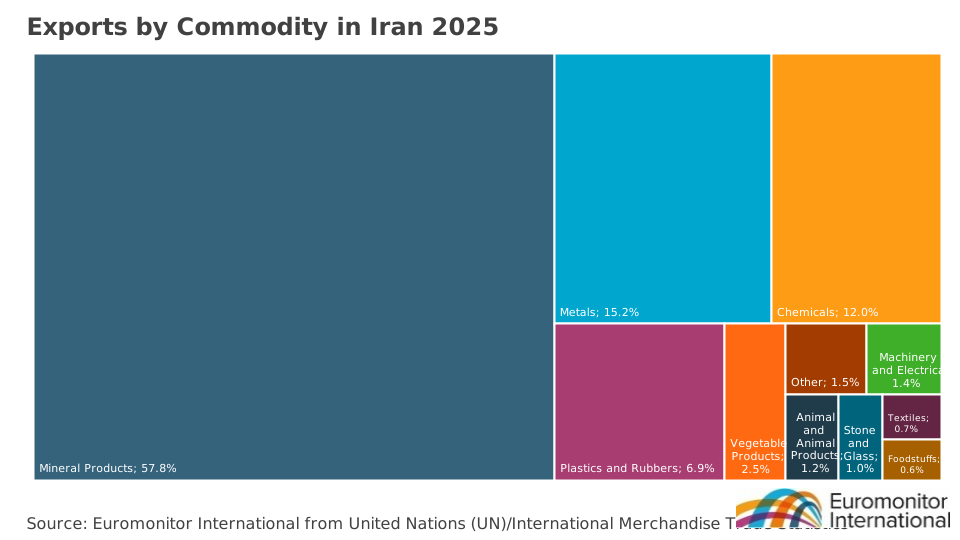
In the near term, heightened geopolitical tensions are expected to weigh on global GDP growth, while contributing to inflationary pressures. Short-lived disruptions may result in a marginal reduction from the 3.2% real GDP growth forecast for 2026; however, a prolonged war could materially reduce global GDP growth prospects, particularly if energy markets remain volatile and supply constraints persist.
Fears of slower global growth and surging energy costs from the Iran war triggered a broad sell-off in equity markets worldwide. At the same time, investors fled to safe-haven assets, sending gold to record highs and boosting the US dollar and Japanese yen.
Beyond financial markets, broader economic and industry effects are expected to materialise, due to the pervasive role of oil and its derivatives across global value chains. Shipping companies are already facing higher insurance premiums and rerouting costs, while airlines are absorbing increased expenses from delayed, cancelled and diverted flights.
Over time, energy-intensive manufacturing sectors, such as chemicals and plastics, may encounter feedstock shortages and rising input costs, given their significant reliance on refined petroleum products. Agricultural markets could also see upward pressure on fertiliser prices, creating knock-on effects for food producers and, ultimately, consumers.
Technology and service sectors may prove relatively resilient in the short term; however, prolonged disruption would likely extend the impact more broadly, as energy remains a foundational input across supply chains and operational systems.
Commodities: Strait of Hormuz is the key determinant
Energy commodities are the most directly affected, reflecting supply risks from Iranian oil fields and potential disruptions in the Strait of Hormuz. According to the US Energy Information Administration, the Strait handles roughly 20% of global petroleum liquids trade, and serves as a key transit route for liquefied natural gas exports. Although the Strait, the world’s most critical maritime energy chokepoint, has not been closed de jure, the threat of closure and early logistical disruptions are already evident, risking oil price surges, inflation and travel disruption, with the ultimate impact depending on the duration of the war. Shipping activity in the region fell sharply within 24 hours of the war starting, with many vessels turning back, diverting to alternative routes or idling in the Gulf of Oman.
The war is also creating near-term forward-looking risks that extend beyond the immediate market reaction. First, uncertainty surrounding energy flows through strategic chokepoints is increasing, complicating procurement and supply chain planning. Second, heightened geopolitical unpredictability is adding to leadership and policy uncertainty at the global level, reducing business confidence. Third, volatility in shipping costs is rising, reflecting higher security risks and rerouting pressures.
Commodity markets are already reflecting this instability. Brent crude futures, the international benchmark, climbed to USD84 per barrel at the time of writing this article (3rd March), underscoring the sensitivity of energy prices. Beyond energy, food prices may face upward pressure through higher oil-linked transport and input costs. However, no major supply disruptions have yet been observed in grains or base metals beyond short-term volatility.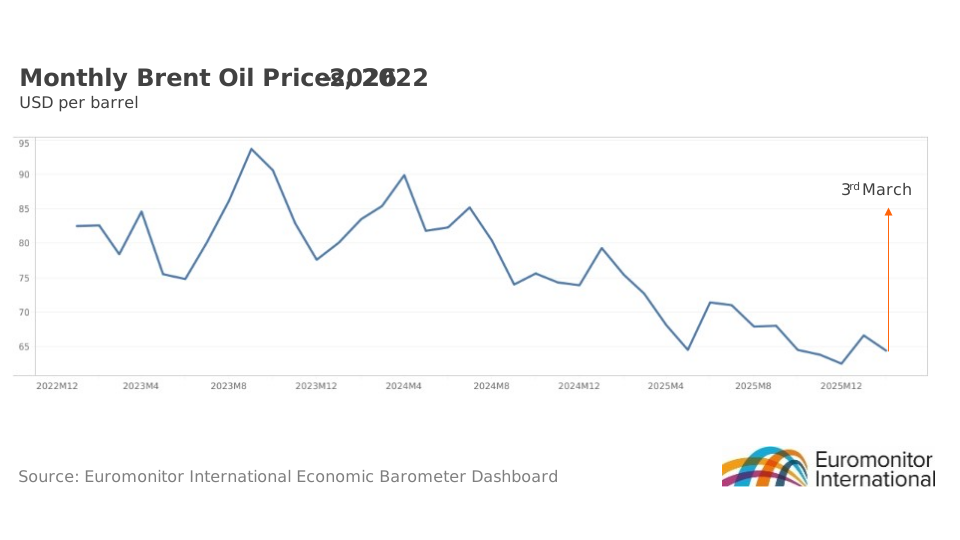
Consumers worldwide potentially face higher energy and food prices, effectively acting as an inflationary tax. The recent jump in crude oil prices has already translated into more expensive transport fuels within days, putting pressure on previously stabilised inflation levels. Lower oil prices had been a key factor in easing inflation over the past year, but the US/Israel-Iran war is likely to reverse that trend.
The impact will be particularly pronounced in energy-intensive and oil import-dependent regions, such as Asia. Over time, higher fuel costs are expected to ripple across economies, increasing costs in multiple sectors where energy is a significant input. In markets like India, Thailand and the Philippines, where energy imports drive a significant share of inflation, the pass-through to transport and food prices will be faster.
Uncertainty itself is also economically relevant. Heightened geopolitical risk can weigh on consumer confidence and delay discretionary spending. Consumption growth had already moderated entering 2026; a prolonged war would increase downside risks to household spending forecasts.
Duration is the defining variable
Market expectations hinge on duration. A short-lived war that empowers maritime flows to be restored within weeks would likely limit sustained supply disruption and contain inflation spillovers. Oil prices could retreat once risk premia ease. A longer war, though, potentially extending four to five weeks, as suggested by US officials, would increase the probability of Brent exceeding USD110 per barrel, add 1-2 percentage points to inflation in exposed economies, and raise recession risks. At present, markets are recalibrating to geopolitical uncertainty rather than pricing a definitive outcome.
Learn more about Market Volatility in our report Market Volatility: Risks and Opportunities Ahead.