
Fintech is accelerating a structural transformation in payments and lending, driving significant uptake of digital wallets, stablecoins, and buy now, pay later (BNPL) offerings, while facing heightened challenges from increasing payment fraud. Payment companies and merchants must manage an environment where consumer demands, security risks and competitive pressures are changing more rapidly than before.
Fraud losses in the 47 markets examined surpassed USD30 billion in 2025, with the pace of losses expected to continue rising.
Source: Euromonitor International
Fintech drives broader credit and payment access
Financial technology has altered the way consumers obtain and utilise credit, with global consumer credit increasing by USD4.1 trillion between 2020 and 2025, and predicted to reach USD25.5 trillion by 2030. While card lending is still the primary form of credit, alternative models like BNPL have expanded quickly – BNPL value across the 47 markets researched nearly reached USD350 billion in 2025, reflecting a USD250 billion rise since 2020.
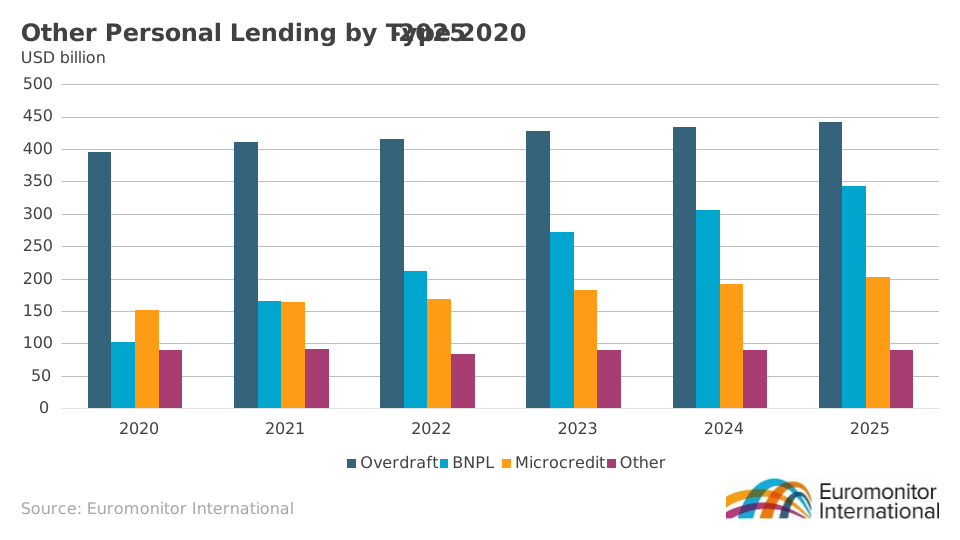
As consumers take on more debt – often in response to high inflation – financial institutions are exposed to greater risks. In 2025, the share of rolled-over card lending reached 72.5%, its highest since 2020, raising concerns over possible increases in non-performing loans if economic conditions worsen.
Digital currencies and cross-border transactions: Reduced cost, faster settlement
Adoption of digital currencies, especially stablecoins, is moving past initial trials to mainstream implementation, offering lower cost and faster cross-border settlements. Traditionally, remittance fees have ranged from 3% to 20%, whereas stablecoin platforms can cut costs to below 1%. This is particularly beneficial for international merchants seeking better margins and cash flow.
Leading payment companies are investing to maintain their positions. In March 2026, Mastercard purchased BVNK, a UK-based stablecoin platform, for USD1.8 billion, supporting quicker and more affordable payments and extending payment acceptance alternatives.
Clearer regulations in major markets are aiding this transition, but competitive dynamics are evolving. As digital currencies become more advanced and immediate, the balance between government-issued money, private enterprise and technology platforms is shifting.
Security remains a core focus
With digital payments on the rise, security threats have increased. The value lost to card payment fraud more than doubled between 2020 and 2025, to USD30 billion, representing 0.06% of all card payment value – the highest level recorded. Furthermore, the proportion of fraud occurring online grew from 68% to 84% over the same period, with the US responsible for 80% of global card fraud losses.
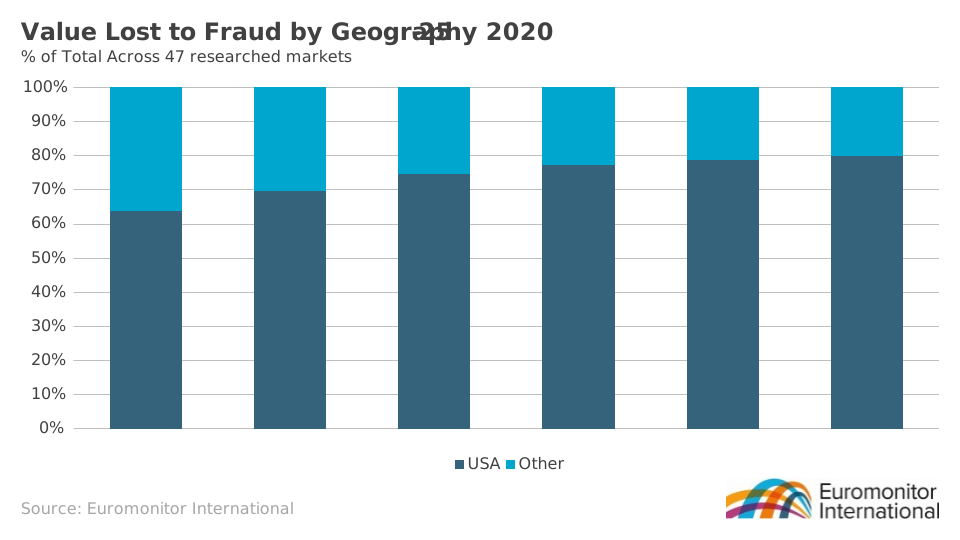
Fraudsters’ strategies continue to evolve quickly, challenging existing defences. The need for comprehensive security, supported by industry and regulatory efforts, remains pressing.
Future directions: Priorities for payment sector leaders
The payments sector will increasingly be shaped by the convergence of flexible funding, digital currencies, and enhanced security measures. Consumers can expect to see a broad range of payment and credit options, and merchants which are slow to adapt risk losing market share. Digital wallets and stablecoin platforms are poised to further drive down costs and transaction times, while security remains a foundational requirement.
Future developments are likely to emphasise the integration of fintech throughout the payments ecosystem, with acquisitions and partnerships promoting further innovation. Payment companies and merchants are advised to focus on digital currency infrastructure, broaden customer funding options and implement sophisticated security technologies – whether developed internally or sourced through partnerships – to maintain relevance and user trust in a rapidly changing market.
Fintech is fundamentally transforming digital and card payments by introducing new security measures, alternative funding models, and additional transaction channels. Merchants and payment providers are encouraged to adopt these advances to maximise the benefits.
Additional analysis is available in the full report, The Future of Payments: How Fintech is Transforming Lending and Security.