
Finovate Europe 2026 returned to London’s InterContinental O2 this February, bringing together more than 1,000 senior decision‑makers for two days of product‑led fintech insight. In contrast to larger festival‑style events, Finovate maintained a deliberate focus on what is deployable within real‑world banking constraints such as legacy systems, regulatory oversight and long procurement cycles.
Across the agenda, several themes consistently emerged: AI deployment, payments innovation, embedded finance, fraud prevention, risk management and digital assets. The unifying message was clear. Fintech is entering a phase of convergence, where these capabilities increasingly operate as an integrated stack rather than as standalone innovations.
AI and trust infrastructure move centre stage
AI featured prominently throughout Finovate Europe 2026, and the framing has decisively shifted. Rather than experimentation, discussions centred on production‑grade deployment, with strong emphasis on governance, explainability and integration into existing bank operations. Risk and compliance teams were positioned as active enablers of AI strategy rather than downstream control functions.
Fraud prevention and identity were presented at Finovate as foundational infrastructure. Euromonitor notes that the UK’s mandatory APP fraud reimbursement regime, consolidated in 2025, has structurally increased the importance of advanced controls, accelerating investment in AI‑driven fraud detection, tokenisation and issuer-merchant collaboration. The conference narrative closely mirrored this reality: trust infrastructure is no longer optional, but a prerequisite for sustainable growth.
Embedded finance, BNPL and convergence at checkout
Embedded finance emerged as a strategic priority at the event, particularly as banks grapple with platform‑led ecosystems that increasingly own the customer interface. Speakers emphasised the need for financial institutions to reposition themselves as trusted infrastructure providers, embedded seamlessly within broader digital journeys.
Buy Now, Pay Later (BNPL) featured prominently as both a growth driver and a regulatory inflection point.
Source: Euromonitor data confirm that BNPL adoption recorded double‑digit growth in the UK in 2025, with fashion accounting for nearly half of all BNPL transactions, reflecting its role in facilitating smaller, frequent online purchases.
Online payments: Cards dominate but cash still matters
Discussions around embedded finance and digital journeys at Finovate also reflected how consumers behave online. Euromonitor’s Voice of the Consumer: Digital Shopper Survey, fielded April 2025, shows that credit and debit cards remain the most popular online payment method, with 73% of connected consumers selecting cards as one of their preferred ways to pay online. Their enduring dominance reflects cards’ convenience, perceived security and near‑universal acceptance across e-commerce platforms.
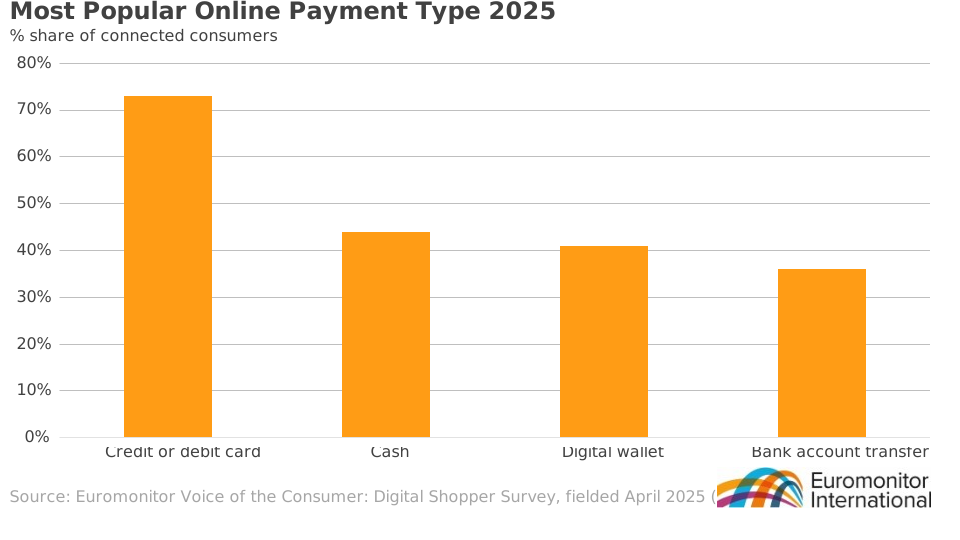
The data also highlight an important nuance. 44% of digital consumers still identify cash as a preferred method for completing online purchases, a share unchanged since 2021. This persistence is partly explained by the continued expansion of click‑and‑collect and pay‑on‑delivery options, which allow consumers to order digitally while settling transactions offline.
Beyond fulfilment models, attitudes towards safety and privacy also play a role. In 2025, around 35% of digital consumers reported that they view cash as a safer means of payment than any other option, including credit and debit cards. This lingering trust gap helps explain why concerns around identity, authentication and fraud prevention featured so prominently at Finovate, even as digital payments dominate transaction volumes.
From demos to deployment
Finovate Europe’s demo‑first format reinforced the event’s defining message. With over 30 companies showcasing live solutions across fraud prevention, embedded finance and AI‑driven automation, the focus was firmly on deployable, scalable technologies.
The event captured a market at a point of alignment. AI is being operationalised with governance in mind, payments innovation is shaped by regulation rather than racing ahead of it, and trust infrastructure has become the foundation for future growth. As Euromonitor’s outlook points to steady, volume‑led expansion, the next phase of fintech will be defined by those able to embed intelligence, speed and security into every layer of the payments experience at scale.
Read our report, The World Market for Payments and Lending, for more analysis on the drivers of consumer and commercial payments.