

Convenience is the key market manifestation of how consumers look to better use time. It is evolving due to shifts in social patterns, such as ageing populations, which demand easier applications for day-to-day activities, smaller families, which must find ways to simplify their lives, and growing urbanisation, leading people to live more hectic routines than ever. What does that mean for businesses worldwide? Essentially, that “time is money” as consumers are willing to spend on products and services that save time and make life easier, as shown in Euromonitor’s Megatrends Quantification Model.
Convenience is the fastest-growing megatrend in developed and emerging economies
Receiving goods and services in the comfort of one’s home, easy-to-open packaging, smart-to-use home solutions, multi-functional products, meal kits, etc. These are just a few examples of how Convenience is present in our lives, indicating a growing and dynamic market that offers opportunities for business to leverage. Euromonitor has identified 10 Megatrends influencing consumption globally and, by exploring consumers’ propensity to spend towards each trend, we identify “Convenience” as the fastest-growing trend in both historic and future periods.
Over 2017-2022, per capita consumer spending on convenience-related products and services grew on average 24% each year
Source: Euromonitor International
With such dynamism, this trend carries implications for most industries. 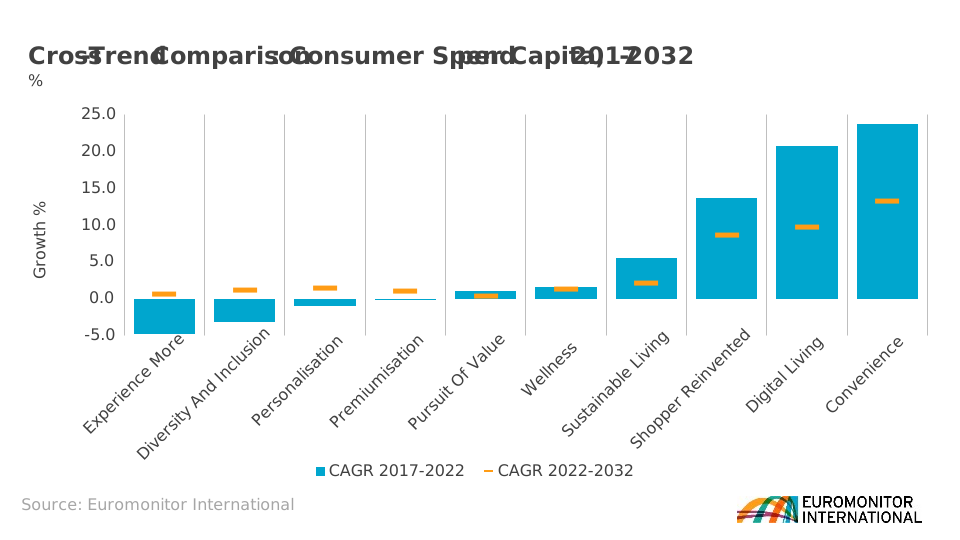
Looking forward, the trend will continue to drive growth worldwide as it is deeply connected with individuals' urge for an easier life.
In 2023, 66.5% of global consumers stated they are looking for ways to simplify their lives and 42% are willing to spend money to save time
Source: Euromonitor International
Adults aged 30-44 are the ones most willing to pay more for time-saving solutions, as evidenced in Euromonitor’s Consumer Lifestyles survey.
Mapping growth opportunities in emergent markets
Euromonitor’s Megatrends Quantification Model enables the identification of markets with the largest opportunities.
Developed countries naturally have the highest per capita spending in absolute terms, led by North America, but we tend to see emerging economies becoming more relevant over time. Asia Pacific is expected to witness the fastest growth in consumer spending on Convenience, with a 16% CAGR (2022-2032) compared to 13% in Eastern Europe and globally. 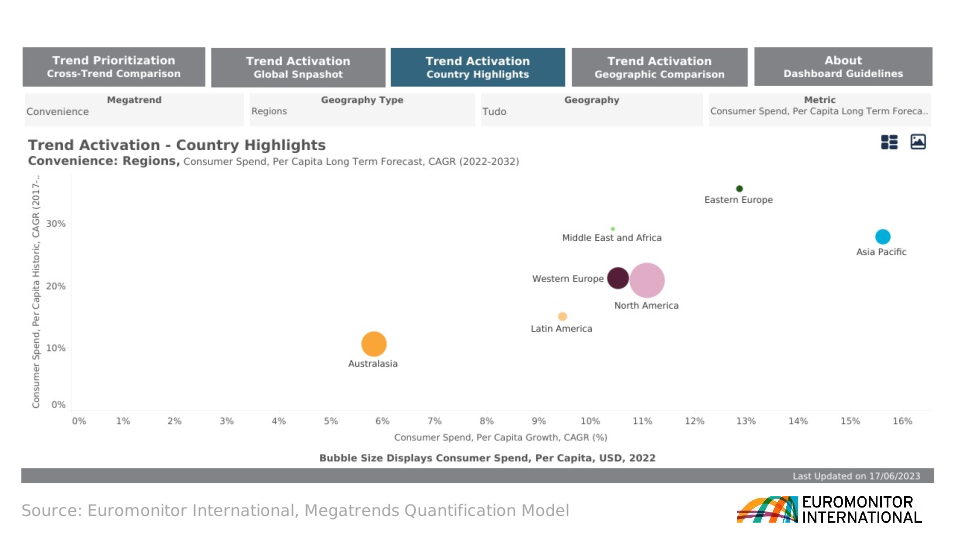
Within emergent markets in Asia, highlight countries are Thailand, Malaysia and Vietnam, all with long-term forecast CAGRs above 18%
Source: Euromonitor International
In these economies, urbanisation and access to mobile internet will remain important drivers for Convenience growth. A key example of how Convenience is being lifted in this region are superapps.
Superapps are booming in Southeast Asia by going beyond e-commerce and meal delivery, clustering a range of daily tasks in a single place, exemplified by MoMo. Their growth comes along with the promotion of access to digital banking and fast payments, which increases convenience by providing a single place for consumers to seamlessly shop and pay. In Vietnam, the recent partnership between Gojek, a platform for ride hailing and food and grocery delivery, and the superapp MoMo, for example, has enabled over 30 million MoMo e-wallet users to access rides and parcel deliveries within Gojek, which formerly only accepted cash or bank card payments in the country.
Cross-trend implications: Leveraging Convenience to optimise growth
While it is clear that Convenience has much to gain from the Digital Living megatrend, it must not be interpreted as synonymous with e-commerce, nor is it limited to digitally powered solutions. There is opportunity to combine Convenience to other growing megatrends, such as Sustainable Living or Wellness.
Players orientated towards Wellness, for example, will likely gain extra attention by incorporating simplicity, speed and consumer comfort in their offerings. This is exemplified by a rise in flexible gym subscription models, simplified skin care routines, fast-paced weight-loss medications and functional claims in snacks and RTD beverages. With YoPRO protein-added dairy products, Danone’s convenience-focused approach to attract fitness enthusiasts ranges from product development to distribution: In Brazil, products are available in supermarkets, convenience stores and pharmacies to maintain close proximity to consumers’ need, and the brand recently launched a yoghurt pouch that remains stable for up to eight hours without refrigeration, thereby suitable for commuting.
Convenience also helps drive new developments in industries as varied as Consumer Health, Packaged Food and Dairy. Food and drink players can spur Convenience through the facilitation of consumption, either at home or on the go. In Poland, for example, Arla Foods introduced family-sized carton packages for its Starbucks ready-to-drink coffee line, targeting domestic consumption. Polish consumers can now easily enjoy barista-style iced coffees in the comfort of their home without the need to head to a coffee shop.
Megatrends analysis leverages consumer habits to bring to light entrenched needs hidden in consumption patterns. The quantification of megatrends serves to help businesses set their priorities when evaluating new investments, product launches and value propositions. Furthermore, the combination of qualitative analysis with quantitative data will help businesses take informed decisions for innovation and growth, by understanding how they can turn simplicity and time into products for end-consumers.
Watch our video 10 Megatrends to Watch to learn more about Megatrends and how they shape the business environment.