
Most claim strategy is trendspotting and activation. Brands scan the cultural landscape for what consumers are currently anxious about or aspiring towards and build claims around that signal. Clean label, gut health, immune support, stress relief; each of these has had its moment, and each has faded or been diluted as the cultural mood shifted and the category filled with me-too competitors. The underlying logic is demographic and attitudinal: find a segment, find their current focus or fear, match your claim to it. There is a more durable, sticky alternative. Alongside following trends, we should follow roles.
Social roles, identity and preferences
Social roles, such as parent, pet owner, host, homemaker, caregiver, are not lifestyle choices that consumers update over time. They are identity structures. Psychological research on role-based identity (Reed et al., 2012) shows that individuals who occupy sustained social roles don't simply adopt new behaviours, they adopt a new evaluative lens through which all decisions are filtered. Purchases become acts of role performance: a way of verifying, themselves and others, that they are living up to what the role requires.
This is what separates role-based consumption from trend-based consumption. A trend creates temporary preference and short-term exposure and adoption. A role creates permanent accountability. And accountability, not preference, is what makes a product claim structurally necessary for a consumer, leading to long-term patterns.
The caregiver: A study in role-driven claims
Of the 378,000 SKUs worldwide carrying the balanced nutrition claim, the majority – 210,000 – belong to pet food, with a further 112,000 in consumer health supplements and 38,000 in baby food and child nutrition
Source: Euromonitor’s Via data, 2026
The top three brands using the claim are Royal Canin, Concept for Life, and PediaSure: two pet food brands and a child nutrition brand. For reference, in pet care and in baby food, those SKUs account for more than 10% of the industry’s product offerings worldwide, a significant and stable proportion of these categories.
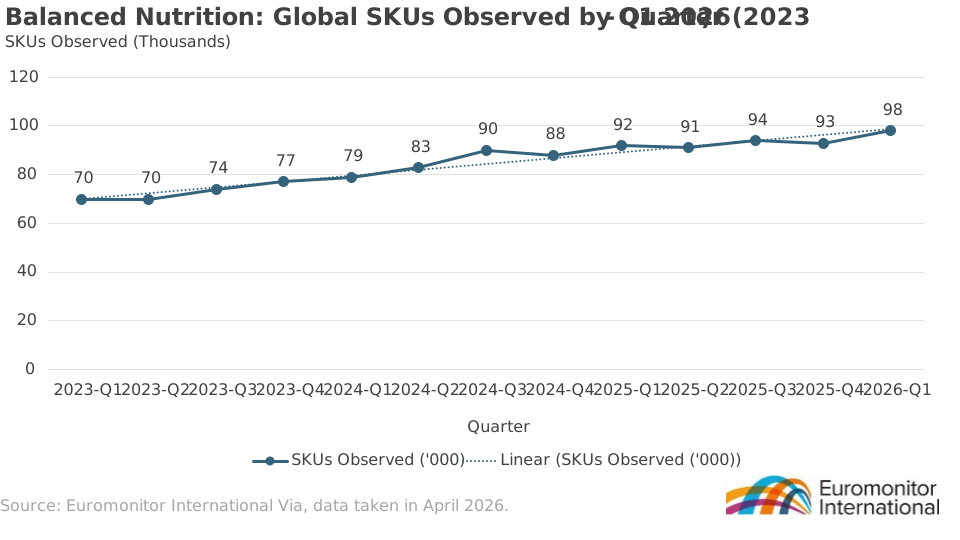
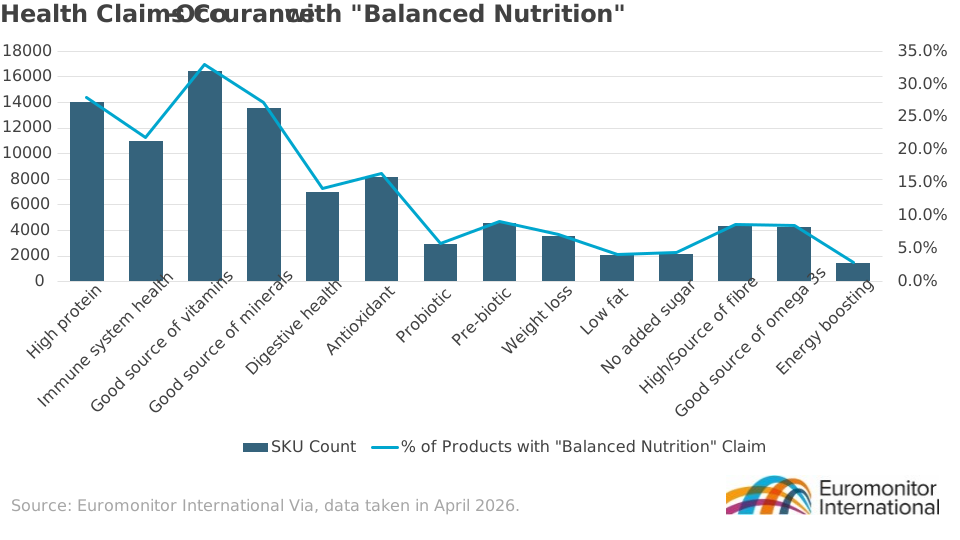
The claim functions as a semi-medicalised trust anchor. It promises that the product was developed against a health standard, that nutritional research underpins it, and that the manufacturer accepts accountability for a being who cannot give feedback. For a caregiver, this is not a bonus feature. It is the minimum acceptable criterion, which is exactly what durable brand trust is built on. If we further examine the co-claims that are found with it, all promise healthy nutrition for those we look after, as a guarantee of the product composition being healthy.
Other roles, same claim architecture
The caregiver is one instance of a broader principle. Several other social roles generate equally stable, equally predictable claim needs. The provider, the organiser, the host – all offer sticky identities and role obligations that will ensure a more stable product positioning.
Just like trend application, social roles have their own benefit for product positioning strategy, and both provide different benefits. When thinking of consumers as people with social identities, the question becomes “What role does this consumer occupy, and what does that role require them to get right?”. This question leads to claims that become structural expectations in a category, the kind that competitors must match to be considered, and that brands must maintain to stay trusted. Any claim that earns the trust of a role-based buyer doesn't just win a purchase – it becomes embedded in how that role is performed.
Read our latest Competitor Strategies in Innovation briefing for more analysis on what drives staying power beyond product launches.