

As economic pressures and digital fatigue reshape priorities, the Euromonitor International Voice of the Consumer: Lifestyles Survey 2026, reveals where value, connection and aspiration are being redefined, and how brands can respond.
Redefining frugality: Value as a social indicator
Affordability remains a primary concern, with 72% of consumers expressing anxiety about rising daily expenses, according to the Euromonitor International Voice of the Consumer: Lifestyles Survey, fielded January to February 2026. Frugality has evolved from a private necessity to a visible indication of intelligence and good judgement. Seeking value is now openly celebrated: 43% of global consumers enjoy discovering bargains, while 41% compare prices online at least once a week.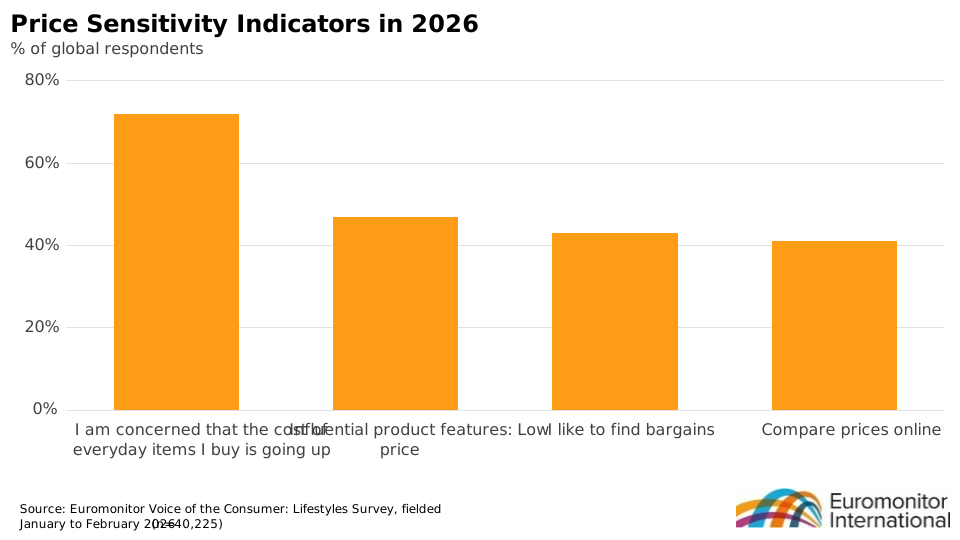
The influence of social media has intensified this shift in perception. TikTok’s #dupe trend, endorsed by influencers like @budgetbabe in the US, highlights affordable alternatives to premium products, positioning frugality as a form of social proof. Brands aligning affordability with consumer identity through private label, transparent pricing, and customised rewards are best equipped to appeal to this trend.
From constant connection to selective engagement
Widespread digital engagement is prompting consumers to ration attention and prioritise intentional interactions. While 57% of consumers affirm they would feel “lost” without internet access, 32% cite significant daily stress resulting from being online. This dynamic is supporting a migration from mainstream digital platforms to more curated, quieter environments.
Brands are responding by shifting focus to quality rather than volume in digital engagement or encouraging consumers to disconnect altogether. For example, Heineken promotes mindful offline connections through its “Social Off Socials” campaign, which encourages attendance at phone-free, in-person events. In the coming year, brands are increasingly expected to respect cognitive boundaries, streamline the consumer journey, and offer restorative experiences that address digital fatigue.
Community-driven consumption
Peer networks and local ties are exerting increasing influence on consumer confidence and purchasing decisions. Almost one third of consumers have bought from brands that share their values, while 49% place importance on active community involvement.
Local and independent brands are viewed as more reliable and higher in quality too, especially in the context of recent supply chain issues. As a response, global companies are incorporating localised (“glocal”) approaches. Whirlpool (US) adapts product features for the Indian market, and Coca-Cola (US) integrates local cultural elements in China. Red Bull’s (Austria) Kumite esports competition in Paris highlights community-centred interaction, fostering collective participation and emotional connection.
Evolving prestige: The new face of luxury
Luxury is transitioning away from ownership based on status towards purpose-driven experiences and personal meaning. The resale sector, valued at USD41.6 billion, illustrates a growing consumer preference for circularity and accessibility.
Over 55% of consumers now prioritise experience-based spending, with 22% expecting to increase their outlay on unique experiences
(Source: Euromonitor Voice of the Consumer: Lifestyles Survey, fielded January to February 2026 (n=40,225)
Brands such as Rolex (Switzerland) are establishing pre-owned products as desirable entry points, and DUA by Augustinus Bader (Germany/UK) combines science and pop culture to deliver accessible, high-identity offerings for Gen Z and millennials. The future of luxury is defined by modular, tailored, and value-aligned products and services that expand access while sustaining a sense of aspiration.
Emotional consumption and the emergence of “feel-good” products
Emotional considerations have become central to routine purchasing decisions. Rising stress, digital overload, and diminished social interaction are driving consumer demand for products that offer comfort, relief, and positive emotional impact. Brand evaluation increasingly hinges on emotional response rather than mere function or cost.
Businesses are responding by innovating with empathy, integrating indulgence with wellness or emotional reassurance and through that gaining loyalty across consumer groups. For example, Marks & Spencer’s “Brain Food” snack range, developed alongside the British Nutrition Foundation, targets consumers looking for cognitive and emotional support.
Outlook: The move towards purpose-driven loyalty
The integration of affordability, attention, and authenticity is reshaping consumer value perceptions. To succeed, brands must link value to identity, streamline decision-making, and embed significance in each consumer interaction. Leading companies will transform frugality into an aspirational trait, encourage mindful engagement, and foster genuine community involvement.
Further insights are available in the full report, Voice of the Consumer: Lifestyles Survey 2026 Key Insights.
This article was produced with assistance from AI. All information originates from Euromonitor and is based on our report, Voice of the Consumer: Lifestyles Survey 2026 Key Insights. The content has undergone a thorough review to ensure maximum accuracy and integrity.