
China has remained at the centre of US tariff policy in 2025, with rates repeatedly raised and rolled back over the course of the year. For companies manufacturing in or sourcing from the country, the shifts have translated not only into higher import costs but also greater uncertainty when making long-term investment decisions. Even so, China continues to play a critical role in global supply chains and remains an important market for final sales.
Trade volatility is pushing FMCG firms to rethink China exposure
FMCG companies are facing mounting risks in China as trade policy volatility intensifies, including renewed US tariffs and changes to the de minimis rule, prompting many to reassess their exposure to the country. To mitigate these risks, firms are shifting production elsewhere or adopting “China+1” strategies and diversifying supply chains across regions. Newell Brands, for instance, has moved production to Southeast Asia while also expanding manufacturing capacity in the US. The removal of de minimis exemptions has also pushed platforms such as Shein to relocate warehousing operations to the US. At the same time, China’s cost advantage is eroding as manufacturing wages rise, accelerating a broader shift by global brands towards sourcing from Southeast Asia.
Relocation from China is difficult due to a dense supplier network
Despite significant risks, China remains the primary manufacturing hub for industries like apparel, footwear, textiles, and toys, accounting for up to half of global production in these industries. The country’s deeply integrated supply chain, built over decades, offers cost efficiency and rapid scaling that newer locations cannot easily match.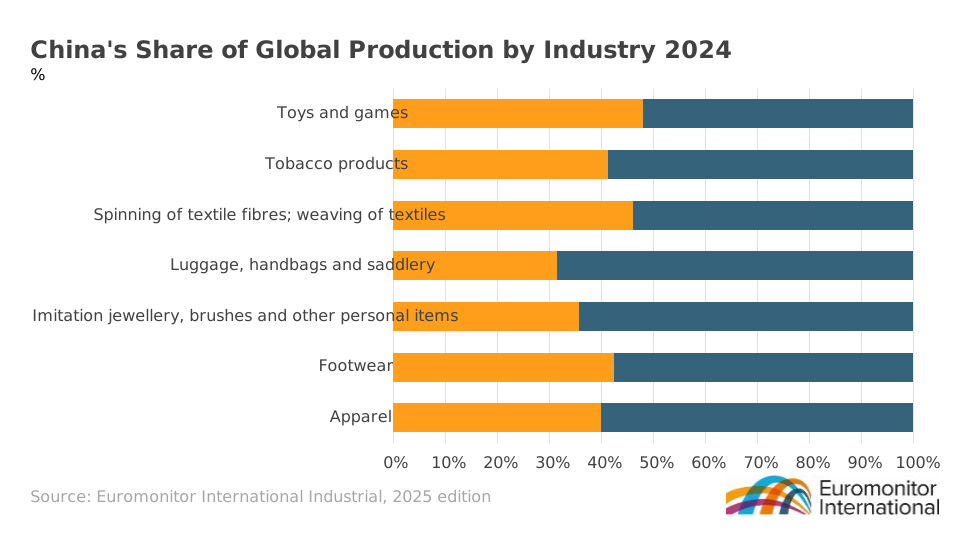
China offers consumer markets with unprecedented scale
Years of robust economic growth and rising household incomes have created a multi-tiered consumer market in China on a scale unmatched by most other countries. The affluent population continues to expand, with an estimated 2.4 million millionaires in 2024, a figure expected to climb to 3.6 million by 2030. The middle class is also growing, underpinning demand for added-value quality products. At the same time, China’s ageing population, 212 million people aged 65 and over, is driving demand for nutrition and wellness goods, while younger urban consumers are fuelling growth in beauty, lifestyle and digital-first brands.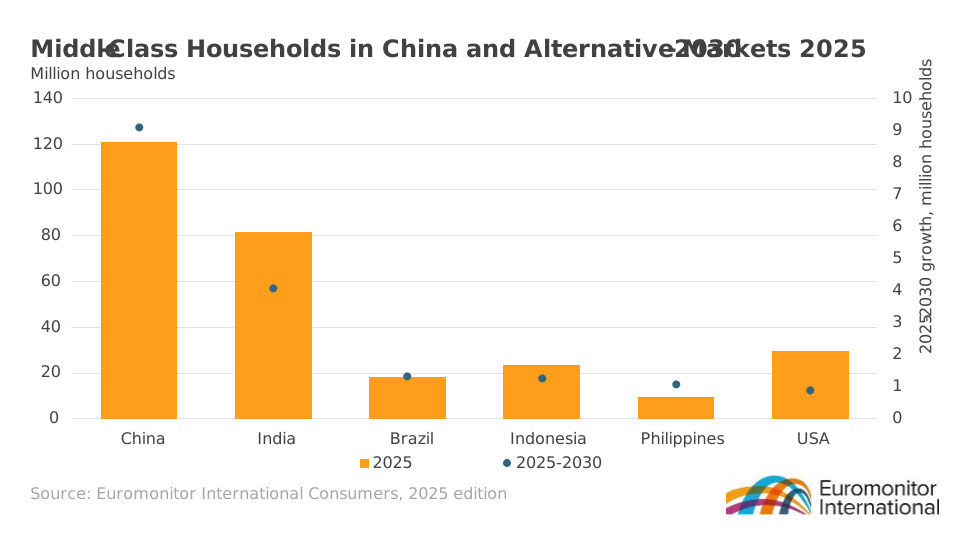
Winning in China’s FMCG market requires an agile supply chain and sharper consumer targeting
To succeed in China’s evolving FMCG market, companies must navigate both production and consumer challenges. Rising labour costs and shifting trade policies are prompting firms to diversify production across multiple countries. The optimal manufacturing solution integrates multi-market production, mixing near-market automated facilities with China-based manufacturing to preserve the advantages of established clusters. At the same time, consumer strategies must be tailored to cater to affluent, middle-class, and older consumers, emphasising premiumisation, scalable innovation, and functional nutrition. Integrating these approaches into a unified, data-driven, and adaptive strategy is critical for capturing growth and managing uncertainty in China.
Learn more about FMCGs’ strategies amidst geopolitical risks in our report, Navigating Geopolitical Risks: Strategies for FMCGs.