
Geopolitical risks, including trade tensions, military and political conflicts as well as changing regulations, are now a major concern for global businesses, disrupting markets and supply chains and fuelling widespread uncertainty. To address these challenges, FMCG companies are rethinking their value chain strategies, focusing on smart nearshoring and reshoring, while investing in diversification and more flexible solutions that enable a quick response to changes.
Rising geopolitical risks affect FMCG companies across the value chain
In 2025, geopolitical risks have become a key driver of strategic change for FMCG companies. Trade tensions, driven by US tariff policy, raised US tariffs on imported goods from 3.3% in 2024 to 22.4% in 2025.
The US trade policy shift has driven up sourcing and production costs and introduced significant uncertainty, with further tariff escalations potentially causing a USD4.4 trillion loss in global GDP over 2025-2026
Source: Euromonitor International Macro Model, Trump Total Agenda scenario
In addition, military and political conflicts such as the war in Ukraine, the Israel-Hamas war, and the security crisis in the Red Sea have disrupted trade routes and restricted sourcing and production in affected regions. Country-specific regulations are also tightening, particularly in areas like sustainability and food ingredients, adding another layer of complexity and uncertainty for FMCG businesses.
Smarter nearshoring and reshoring to navigate geopolitical risks
FMCG companies have significantly evolved their strategies to address rising geopolitical risks over the past few years. Before 2025, the approach was gradual diversification with a clear direction of China+1 strategy, meaning moving a part of production from China to countries of Southeast Asia or nearshoring to Mexico for the US market.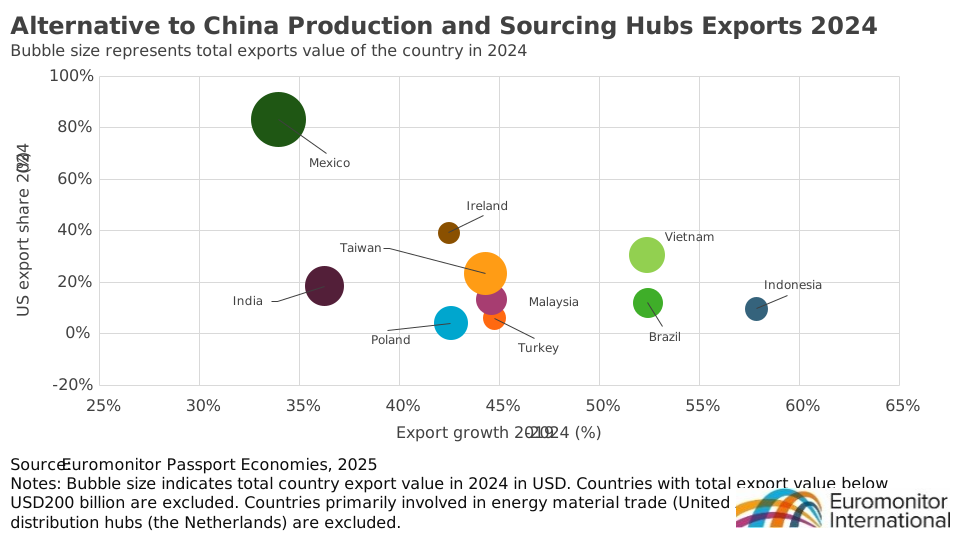
Targeted production shifts to cope with US tariff uncertainty
Uncertainty regarding US trade policy has led companies to make bold shifts in their production strategies. The introduction of 50% import tariffs on India prompted Indian companies to rethink their manufacturing approaches. Pearl Global, one of India's leading apparel exporters supplying brands such as Gap and Kohl’s, announced plans to move production out of India to countries with lower tariff rates, including Bangladesh, Indonesia, and Vietnam. Vadilal Industries, another Indian company, revealed plans to begin manufacturing ice cream in the US by the end of 2025 instead of importing products from India.
Increasing tensions between China and the US have also caused companies with manufacturing operations in China to reconsider their strategies. Apparel manufacturer Shein, known for fast turnaround, low prices, and direct shipping, responded by relocating some production outside of China and opening US warehouses. Newel Brands has also moved part of its production outside of China and expanded automated production in the US.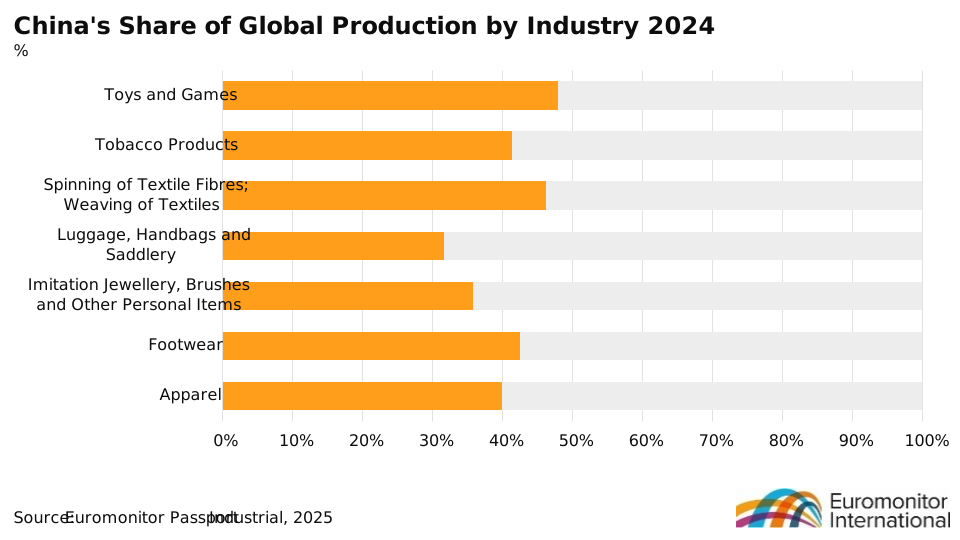
Building long-term supply chain resilience
Geopolitical pressures are unlikely to ease in the near term, with further tariff escalations, regulatory shifts and regional conflicts expected to continue reshaping global trade flows. As these risks become structural rather than temporary disruptions, FMCG companies must shift from reactive adjustments to long-term resilience planning. This means investing in deeper supply chain visibility, developing multiregional sourcing capabilities, and accelerating modular manufacturing to flex capacity when regulations or market conditions change.
Learn more about FMCGs’ strategies amidst geopolitical risks in our report, Navigating Geopolitical Risks: Strategies for FMCGs.