
Recent developments at Saks Global do not suggest a recovery, but rather a re-sorting of relevance within the department stores channel. Saks Global, which operates Saks Fifth Avenue, Neiman Marcus, and Bergdorf Goodman, will emerge from its bankruptcy following USD500 million financing during 2026. However, it will do so with a significantly reduced store footprint, reopening questions about its long-term viability, the future of department store retail in the US, and which players may fill the gap in luxury distribution.
Premium positioning comes into focus
As Saks Global, whose portfolio included the last of the pre-eminent luxury department store banners, has struggled, luxury brands have had to rethink the role of exclusivity within their distribution strategies. Several luxury labels, still needing the broader distribution and exposure of department stores, have begun investing their relationship with mid- to premium-tier players in the channel.
In 2025, Bloomingdale’s, owned by Macy’s Inc, partnered with Burberry and Baccarat. In 2026, Nordstrom will collaborate with Chanel, Christian Louboutin, and Manolo Blahnik for its 125th anniversary celebration. For luxury brands, these collaborations offer incremental reach to a higher-income consumer without materially diluting brand equity; for Nordstrom and Bloomingdale’s, they reinforce positioning at the premium end of a channel otherwise under pressure.
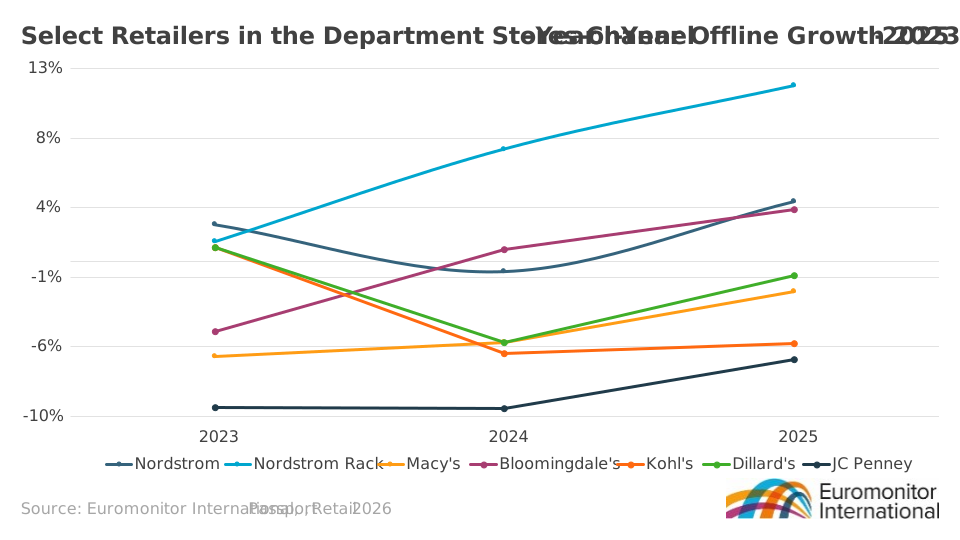
Thus, while offline sales for department stores in the US experienced a contraction of 1.7% in current terms, Nordstrom and Bloomingdale’s continued as frontrunners. Dillard’s and Macy’s benefited from tighter execution of merchandising, though growth remained challenged. Notably, Kohl’s suffered a 5% revenue decline despite successful partnership with premium beauty retailer, Sephora – evidence that structural vulnerabilities remain.
In 2025, 59% of US households earned more than USD100,000; 28% surpassed USD200,000
Source: Euromonitor International’s Economies and Consumers data
This means that over a quarter of US households live within the USD100,000-200,000 income band. This consumer remains aspirational but more value-conscious, a dynamic reflected in the growth of mass and premium brand strategies, from high-profile designer partnerships at Zara, Gap, and Uniqlo to department store portfolios that span full-price and off-price formats.
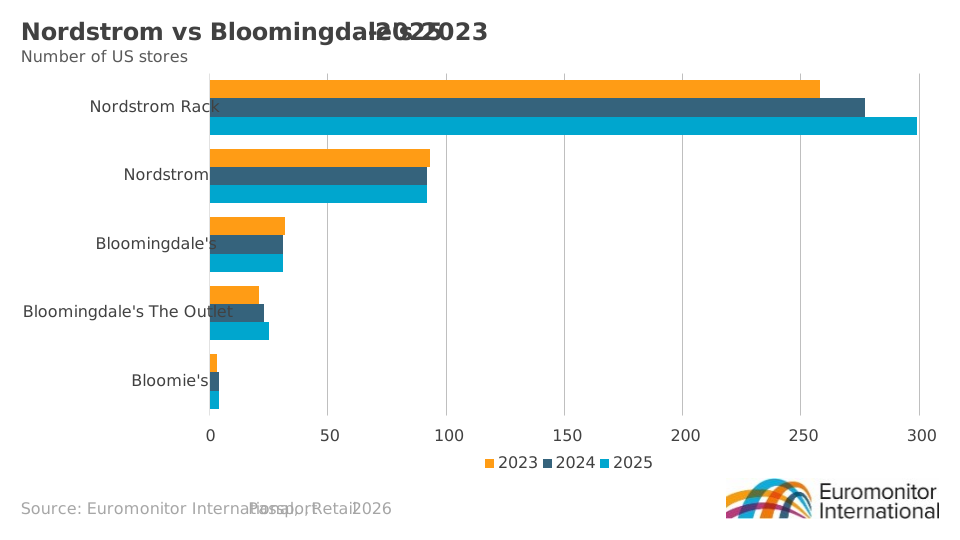
The rapid growth of Nordstrom Rack, Nordstrom’s off-price retail banner, is a case in point. Nordstrom Rack has a higher outlet count and has been growing faster than its flagship, Nordstrom. Nordstrom Rack is positioned as a complementary brand to Nordstrom, even entry-level for some consumers, through a shared loyalty programme and return/exchange policies that allow Nordstrom purchases to be returned to Nordstrom Rack locations. In early 2026, while Nordstrom announced plans to close two full-line Nordstrom department stores, it committed to opening 23 new Nordstrom Racks.
Finding opportunity as contraction continues
The department stores channel is not done downsizing its outlet count, and continued store closures will remain a drag on value growth. Over the next five years, the offline value of the channel is forecast to contract at a CAGR of 5.4% in constant terms, with the steepest decline expected in 2026 as Saks Global closes more stores. Macy’s also continues to right-size its store base and is set to close 14 stores in 2026.
Beyond portfolio, department stores must refine product assortment that does not neglect premium and luxury, despite a challenging macroenvironment. Invoking Bloomingdale’s historic concept of “retail as theatre”, the tactile, multi-sensory experience of offline retail will be an important differentiator against digital platforms, especially if live shopping gains greater traction in the US.
From a product mix perspective, beauty will remain an important category, as premium and luxury consumers are more likely to sustain spending on it despite tightening of discretionary budgets. In an evolving consumer landscape, department stores are well positioned to play an influential role in directing the growing fluidity between luxury and mass, as expert curators of assortment.
For more insights, read our reports, Trending Topics: Next-Gen Online Storefront and Top Five Digital Shopper Trends in 2026.