

Traditional loyalty KPIs are losing relevance. Metrics such as enrolment rates, breakage and points liabilities increasingly fail to show whether a programme is truly effective. They capture activity, not impact. What now matters is whether loyalty schemes measurably change customer behaviour.
In a recent industry discussion hosted by Euromonitor’s loyalty experts, senior executives across hospitality, retail, telecommunications, fitness and wellness, travel and foodservice, among others, examined how loyalty strategies are evolving under pressure from tighter margins and shifting consumer behaviour.
The focus is shifting towards purchase frequency, spend and retention. In this context, redemption is not a cost concern but a behavioural lever – most effective when used to re-engage at-risk customers rather than simply reward already highly active ones. The emphasis is increasingly on incentives that drive outcomes, not broad-based reward distribution. Even high redemption levels can be justified if they extend customer lifetime value.
Subscription models as lock-in, not revenue
Paid loyalty and subscription models are becoming central to loyalty design, particularly across retail, travel and e-commerce.
25% of the top 100 global brands had adopted subscription-based loyalty models by 2026
Source: Euromonitor’s Loyalty Competitor Tracker
Their value lies less in direct revenue and more in behavioural change: prepaid members are more engaged, spend more and are less likely to switch, driving stronger retention and higher spend concentration.
This only holds where eligibility is tightly defined. There are instances where paid subscription models fail to deliver the expected value, as seen with Zalando in apparel and footwear. More broadly, they often fall short when they disproportionately reward customers who would have remained loyal regardless, while failing to effectively engage those most at risk of churn or most responsive to price and incentive structures. Brands are also tightening eligibility thresholds, introducing tiered access structures or tying benefits directly to usage, ensuring incentives are deployed only where they alter customer behaviour rather than subsidising outcomes that would have occurred in any case. Carriers such as American Airlines are increasingly adopting highly segmented loyalty strategies, focusing on specific cohorts, including repeat and price-sensitive travellers, with tailored, behaviour-driven offers rather than broad, undifferentiated rewards.
The platform trade-off
A growing challenge is the role of third-party platforms in customer acquisition and transactions. In travel, food delivery and retail, platforms increasingly mediate the customer relationship. They expand reach and efficiency but reduce direct ownership of the customer and compress margins. In response, brands are shifting towards app-first operating models. Websites are increasingly repositioned as acquisition channels that funnel users into apps, where engagement depth and data capture are materially stronger. McDonald’s, for instance, keeps its website largely informational, using it to direct customers towards its app, where ordering, offers and loyalty are integrated into a single ecosystem.
However, this shift creates a structural trade-off. Not all customers will migrate into apps, particularly lower-frequency users. To address this, brands are testing other engagement channels such as WhatsApp, WeChat or even good old SMS to maintain ongoing interaction without requiring full app adoption.
Smarter loyalty with AI
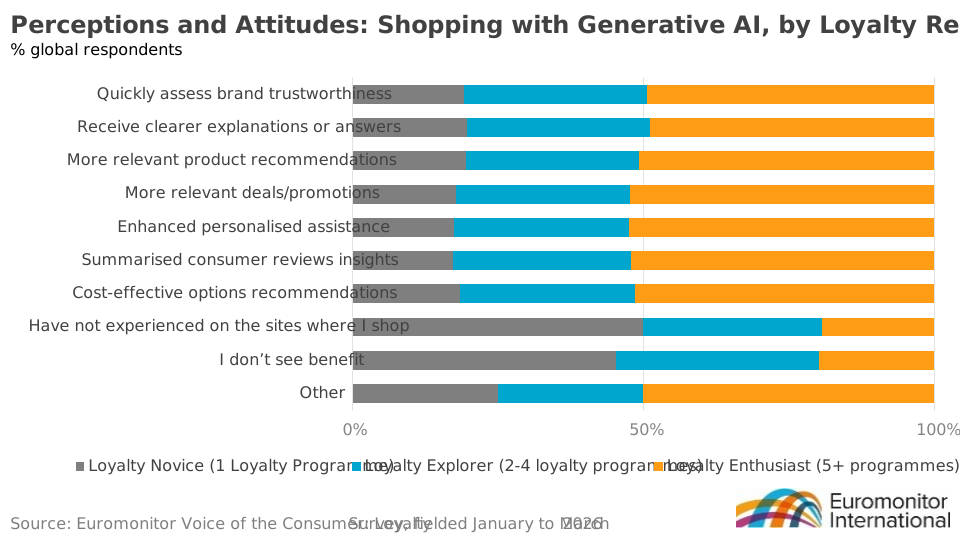
AI is changing how loyalty programmes operate. Broad campaigns are giving way to real-time actions driven by customer behaviour and live signals. The aim is no longer scale, but timing – placing incentives at the point where they are most likely to change behaviour.
Strategic implication
Loyalty is becoming a core system for managing customer value over time. The central tensions are clear: reach versus control, simplicity versus expansion and short-term cost versus long-term value creation. The brands that will lead are those able to translate data into precise action rather than broad engagement – deploying relevant incentives at the right moment without undermining unit economics. Loyalty is no longer about rewarding past behaviour. It is increasingly about shaping future behaviour in ways that compound long-term value.
Read our article, Top Five Trends Shaping Loyalty in 2026, for more analysis.