

Understanding cross‑country variation in loyalty is increasingly important for global brands. Lack of a consistent way to compare markets masks where strategies work and where improvements are needed. Euromonitor’s Loyalty Contribution Index and Voice of the Consumer: Loyalty Survey provide a consistent basis for comparing participation and the value generated by loyalty members across markets. Examining how companies position their loyalty programmes and engage with customers helps businesses plan future strategies. To illustrate how cross‑country differences become actionable, we turn to the airline industry.
Mapping loyalty drivers surfaces clear leaders
Airlines rely on loyalty programmes to retain their most valuable customers and provide stable revenue streams in a sector shaped by fluctuating demand, geopolitical disruptions and expectations of seamless engagement. Well‑designed programmes can smooth revenue by monetising loyalty balances through partner sales and redemptions, whereas undifferentiated schemes tend to see participation and spend decrease fastest during disruption.
Across 20 markets in Euromonitor’s Loyalty Contribution Index for airlines, the matrix highlights differences in both loyalty participation and spend. The US emerges with the highest loyalty spend. Its top-right placement also signals a mature market, with strong programme participation and higher spending among engaged members. Loyalty programmes are deeply embedded in US consumer behaviour, with 64% of consumers reporting reward redemption in Euromonitor’s Voice of the Consumer: Loyalty Survey, fielded March-April 2025. These indicators show how well‑established programmes can convert broad engagement into tangible commercial impact, shaping purchasing decisions and driving meaningful revenue contribution rather than simply expanding membership bases.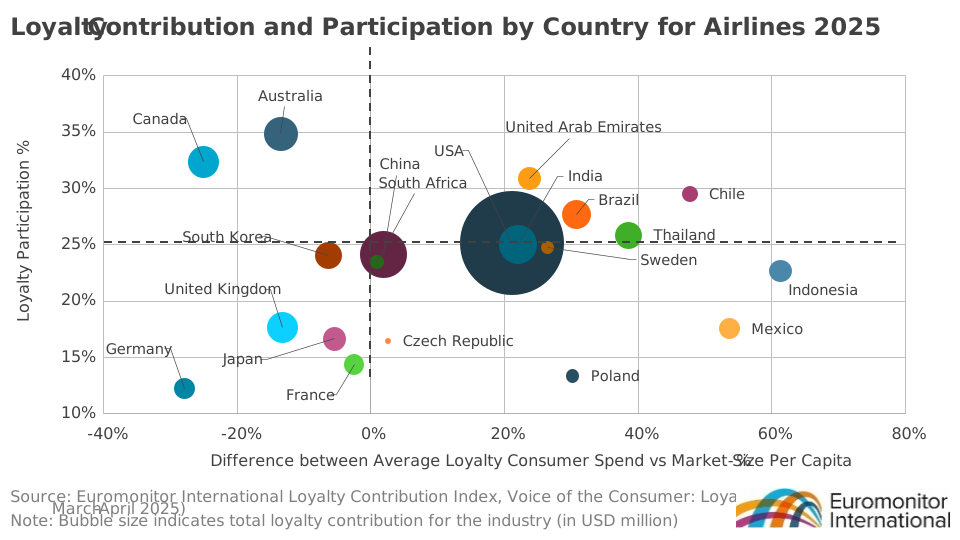
American Airlines positions its AAdvantage scheme to support premium revenue growth and rebuild its presence in corporate travel. It also introduced Instant Upgrade to its programme, allowing members to redeem miles for real-time cabin upgrades with greater flexibility. By simplifying access to rewards and reducing redemption friction, such initiatives translate loyalty participation into stronger engagement and increased incremental spend from members.
Another country with strong loyalty performance in the matrix is Chile, which combines high participation with one of the strongest positive spend differentials. This reflects a mature frequent-flyer culture and the influence of LATAM Airlines Group, whose LATAM Pass programme has expanded digital engagement and partnerships, including the 2025 LATAM Pass Bonus initiative that rewards intermediate milestones to keep members active. The scheme has grown into a multifaceted financial and commercial platform, supported by eight co-branded credit card partnerships and 100+ brand collaborations, including Disney and Amazon.
Activate existing members where spend lags
Other matrix quadrants tell different stories. While Mexico and Poland have scope to raise participation, Canada and Australia show high participation but lower average spend among loyalty members than non‑members. In Australia, a mature duopoly – Qantas Frequent Flyer and Virgin Australia’s Velocity – helps explain the breadth of enrolment but also shifts the priority from acquisition to activation. Qantas’s February 2026 introduction of Status Credit rollover and new ways to earn on the ground targets this need by keeping members engaged between flight cycles.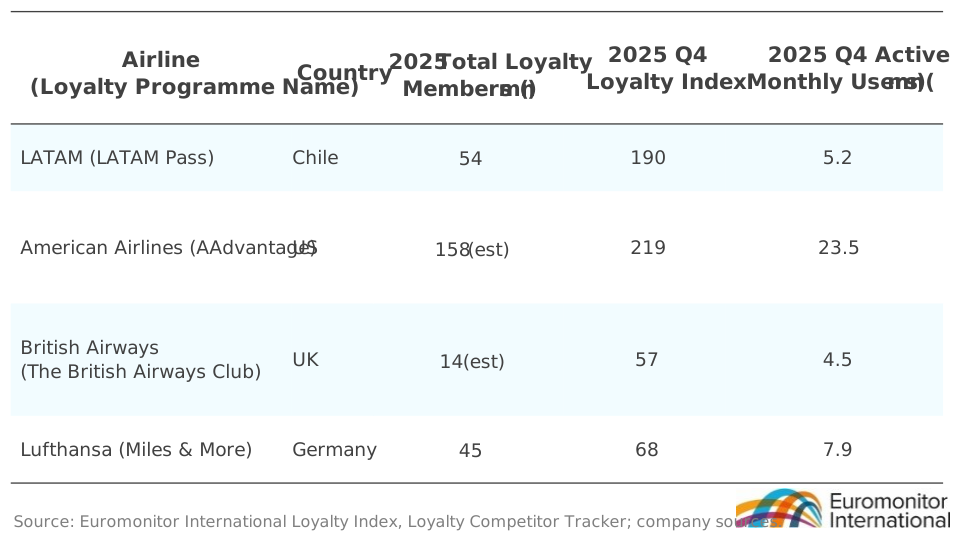
The UK and Germany’s matrix position indicates below‑average loyalty participation and per‑capita spend among loyalty members. In the UK, British Airways rebranded Executive Club as The British Airways Club in April 2025, shifting elite qualification to a spend-based model. Visible member pushback led to reinstatement of a flights-based route for Bronze and Silver, underscoring how programme design and communication affect engagement outcomes. In Germany, Lufthansa’s relaunch of its Miles & More credit card partnership with Deutsche Bank in October 2025 reflects efforts to strengthen loyalty value propositions and encourage more frequent earning and redemption.
These examples show how programme design and market structure interact to shape loyalty outcomes. While engagement persists in markets such as the UK and Germany, translating this into stronger spending depends on how effectively programmes align value, communication and everyday relevance. Comparing company-level signals, such as Loyalty Index scores and active user bases, alongside cross-country benchmarks clarifies where loyalty drives measurable impact and where further optimisation is required.
To learn more about loyalty programmes, explore our comprehensive Loyalty page. Dive deeper into the latest trends and strategies by downloading New Concepts in Loyalty, and discover how to drive customer retention and revenue growth through innovative loyalty solutions.