

Geopolitical challenges are becoming ever more disruptive to travel operations. Rather than isolated incidents, they now serve as a stress test for a new operational baseline in which macro shocks – geopolitical, socioeconomic, and climate-related – are increasingly frequent and prone to cascading through global systems. In this era of polycrisis, resilience, corridor diversification, and digital seamlessness must become central to travel and tourism businesses’ growth strategies. The US/Israel-Iran war and its spillover effects on GCC countries is illustration of this disruptive risk.
Consumer shift to more assured reward horizons
Consumer demand for travel has proved more durable than expected. Despite uncertainty, inflation, and rising costs of living, consumers are changing how they justify travel in response rather than forgoing travel altogether.
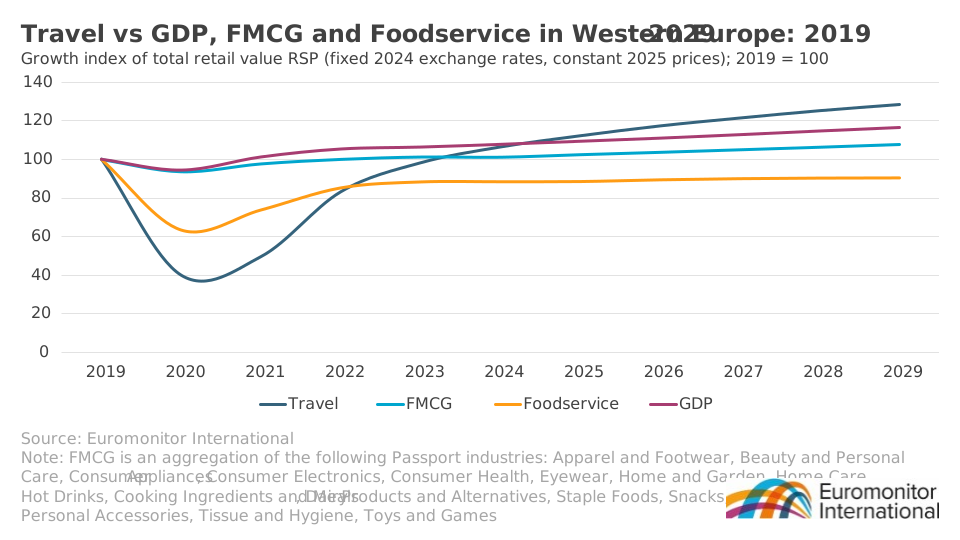
In Western Europe, for example, spending on fast-moving consumer goods (FMCG) has struggled to keep pace with GDP growth, reflecting careful household budgeting. Yet travel has recovered faster since the end of the pandemic, outpacing broader economic expansion.
Travel, like foodservice, sits in the category of attainable luxuries – experiences that provide meaning and relief – but the divergence between the two is instructive. As a more everyday luxury, foodservice spend, in many markets, has not fully regained its pre-pandemic trajectory. Travel, by contrast, has regained momentum and sustained it.
“When the stakes are higher, consumer focus becomes sharper. Escape may be an important driver of travel, but reframing travel as an experience that adds value to consumers' lives helps justify the cost of a big-ticket purchase. Experiences create purpose, and purpose generates the aspirational moments that drive value growth in the industry.”
Stephen Dutton, Global Insight Manager - Travel
Value, in this environment, is being redefined. Consumers spend more per trip when travel delivers meaningful engagement beyond transport and accommodation. Events, curated local experiences, and passion-driven travel generate disproportionate value. That shift is not niche: one in two global consumers say they would rather spend money on experiences than things, per the Euromonitor Voice of the Consumer: Lifestyles Survey, fielded January-February 2025 (n=40,337).
Rethinking networks and corridors beyond flagship long-haul routes
Extensive airspace shutdown across the Middle East has exposed how fragile global air networks have become. In the age of polycrisis, geopolitical complexities fundamentally alter cost structures and capacity decisions. No‑fly zones over Russia have added up to 40% to flight times on some routes from Europe to Asia, for example.
If long‑haul routes are increasingly exposed, destinations are discovering that intra-regional travel can be a stabiliser and a critical growth driver for travel spending. Travellers during polycrisis are more likely to choose nearer, easier-to-execute trips with a clearer pay-off and fewer points of failure than long-haul journeys.
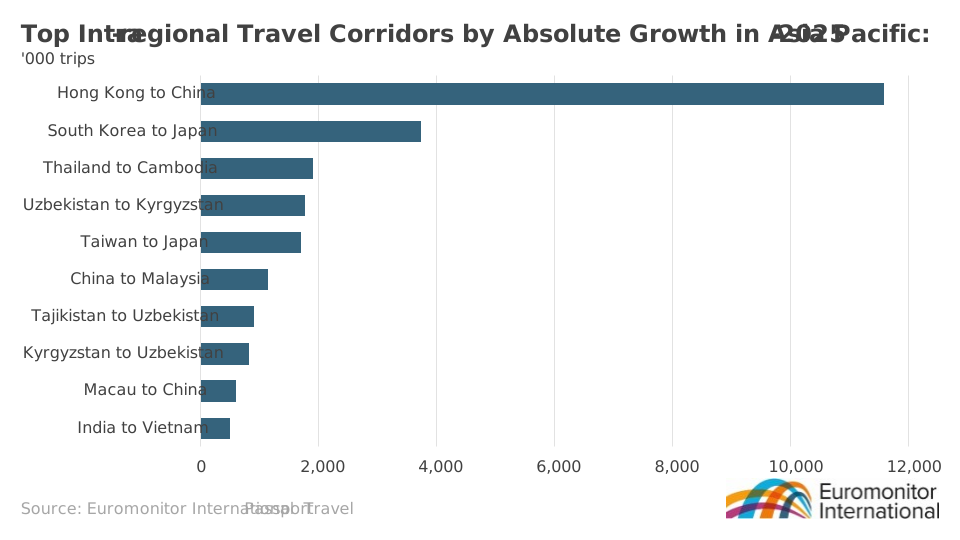
Intra-regional travel has bolstered resilience across Southeast Asia, for example. By reducing dependence on traditionally dominant source markets, destinations have built more diversified and stable tourism bases. Corridor diversification has become an effective strategy against external shocks. Intra-regional travel spending across Asia Pacific is expected to increase by 57% over 2025-2030, dwarfing growth from other regions travelling into Asia Pacific combined.
Making resilience visible to consumers
In polycrisis, resilience is only as valuable as the traveller can feel it. In mass disruption, the first failure is often information: unclear options, fragmented responsibility, and slow hand-offs between airlines, intermediaries, hotels and ground transport. This is why digital seamlessness is converging with resilience as a competitive axis. The underlying premise is that uncertainty is structural, not cyclical, and that the guest experience can no longer be a patchwork of disconnected touchpoints.
The strategic thread across sectors is the same: the travel product is expanding from the transaction to the managed journey. As long-haul networks become more exposed and consumers shorten reward horizons, the winners will be those that sell assurance and meaning together. They will defend value not by chasing the cheapest fare, but by building journeys that feel purposeful when times are uncertain and reliable when the system is not.
For further analysis and related content, see our insights on Market Volatility.