Loyalty is evolving as brands move beyond purely transactional rewards towards more personalised, experience-driven engagement. Emerging trends such as agentic AI, immersive micro-content, choice-based rewards and wellness-led incentives are reshaping how value is created and delivered – with growing focus on high-net-worth consumers who expect tailored, premium and highly relevant experiences. Together, these shifts enable brands to build deeper emotional connections, increase relevance and drive long-term customer retention.
In 2025, 27% of global consumers bought products or services directly from TikTok videos, showing the power of digital touchpoints in loyalty strategies
Source: Euromonitor Voice of the Consumer: Digital Shopper Survey, fielded March 2025 (n=18,918)
Euromonitor highlights the key trends shaping loyalty in 2026, providing insight into what is driving change.
1. “Loyalgentic”: Agentic AI transforms loyalty into real-time engagement
AI is reshaping loyalty by converting data streams into actionable, real-time insights. AI-powered loyalty agents, such as Walmart’s Sparky launched in 2025, now automate perks, redemption and bookings, making loyalty seamless. This shift is supported by 70% of global consumers using voice assistants weekly, and 41% issuing a voice command for purchase (Euromonitor Voice of the Consumer: Loyalty Survey, fielded March to April 2025 (“Loyalty Survey 2025”)). As conversational interfaces become the gateway to brand engagement, brands that offer open API integration will capture incremental share.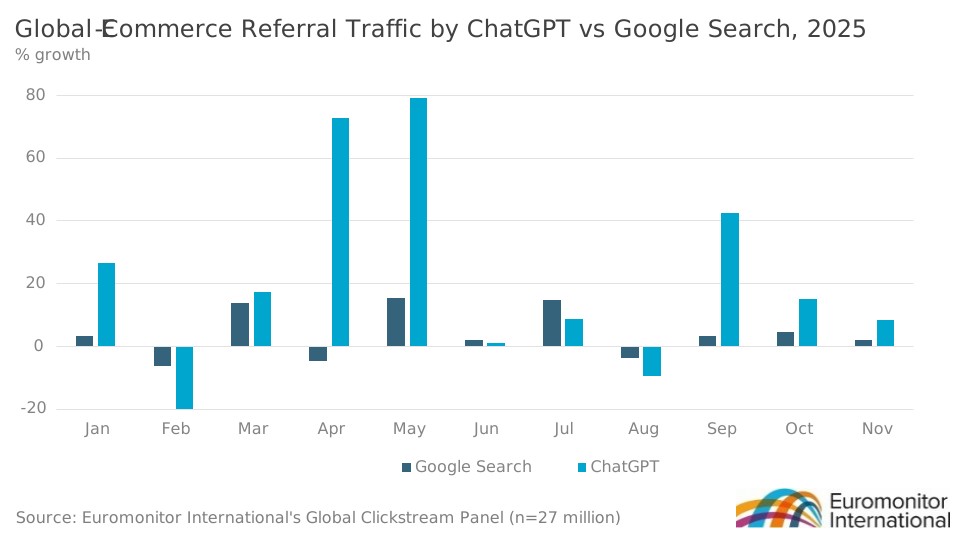
2. Loyalty as a wellness journey
Loyalty programmes are moving from transactional rewards to holistic wellness ecosystems, embedding fitness, nutrition and mental health into daily routines. Private health insurance company Vitality enhanced its programme in 2025 with Google Cloud AI and sleep-based targets via Aura, rewarding healthy behaviours and driving long-term engagement. This resonates, with 60% of global consumers joining multiple merchant paid subscription programmes in 2025 and wellness now a mainstream expectation (Loyalty Survey 2025).
3. The power of choice-based rewards
Customisable earning paths and flexible redemption give consumers control. According to the Loyalty Survey 2025, 54% of global respondents redeem rewards at least once a month, with over 60% of Generation Z and millennials leading. Alaska Airlines’ Atmos loyalty programme, launched in August 2025, allows members to tailor points-earning and redemption methods, while United Overseas Bank offers instant cross-border point redemption. This flexibility deepens engagement and builds ecosystems that are difficult to leave.
4. Micro-content, macro-loyalty
Short-form digital content and micro-dramas are powerful loyalty tools, capturing attention and driving emotional engagement. Taobao, one of China’s largest online shopping platforms, weaves such into its membership ecosystem. Through its DianTao (Taobao Live) platform, users can watch free micro‑dramas and earn rewards that can be cashed out via Alipay or spent on Taobao, turning passive entertainment into tangible value. Meanwhile, in October 2025, Douyin (China’s TikTok) collaborated with C‑beauty brand Winona on a special livestreamed episode of micro‑drama “Great Grandma 3”, enabling instant product purchases tied to the show, illustrating how micro‑dramas/livestreams can become loyalty activation moments. Thus, loyalty is increasingly forged at the point of attention, where immersive content transforms watch time into measurable engagement, commerce and repeat behaviour.
5. Loyalty for the high-net-worth consumer
Loyalty programmes are intensifying focus on affluent consumers, offering exclusivity, personalised rewards and tailored experiences. The launch of India’s Kotak Mahindra Bank’s Kotak Solitaire in July 2025, an invitation-only programme for ultra-premium banking clients, resulted in a 38% rise in average monthly spend and 80% of earned Air Miles redeemed for travel. As the global luxury market moves towards experiential value, brands are using technology-driven exclusivity to strengthen engagement with high-value clients, especially in fast-growing markets such as India.
Strategies for success in the evolving loyalty landscape
As loyalty strategies grow more advanced, brands face stronger competition and new ways to create long-term value. The move towards seamless, personalised engagement – driven by data, digital content and wellness integration – raises customer expectations. Businesses must balance privacy with personalisation, manage complex cross-ecosystem partnerships and ensure loyalty remains a brand asset, not an agent-owned commodity. Success relies on delivering frictionless, emotionally resonant experiences that adapt to changing consumer behaviour. Companies investing in interoperability, flexible rewards and lifestyle-led value propositions will be best placed to secure loyalty in a fast-evolving landscape.
For deeper analysis and practical recommendations, see our report, Top Five Trends in Loyalty in 2026.
This content was written with the assistance of AI. All information is original to Euromonitor and is derived from our report titled, Top Five Trends in Loyalty in 2026. The final article has been thoroughly reviewed by our team to maintain the highest standards of quality and integrity.