
Global passenger EV growth is decelerating. The 49% volume CAGR of 2020-2025 is expected to moderate to 11% in 2025-2030, shifting the agenda from premium niches to affordable scale. In 2025, 63% of consumers agreed/strongly agreed that EVs’ initial purchase price is a significant barrier. They demand quality, safety, charging reliability and residual value.
The way forward coheres around three strategies: unlock breakthroughs in Chinese supply chain models to rebuild the cost base; drive growth of small-to-medium EVs that fit urban life and lower total cost; enhance EV readiness across used-car channels to turn depreciation into accessible value.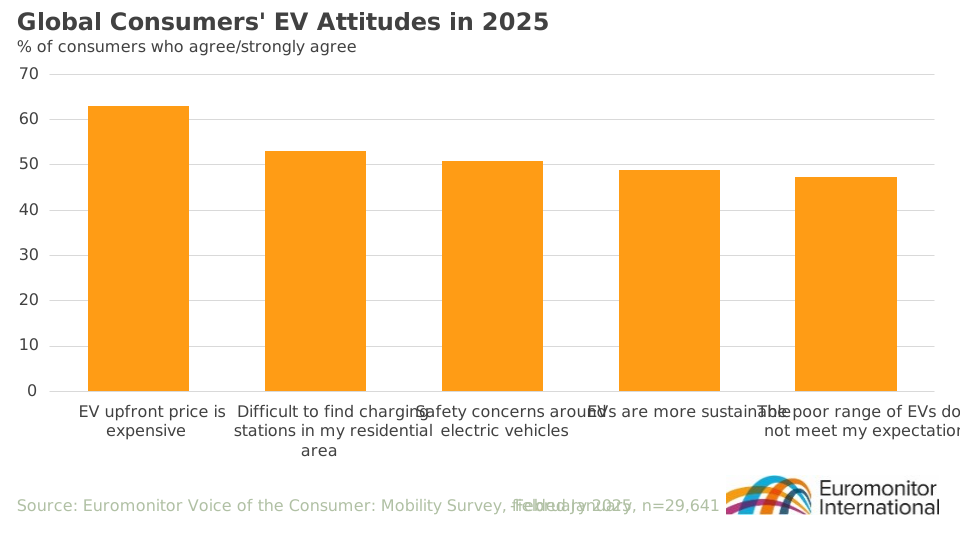
Chinese supply chains reset costs and speed learning
58% of industry respondents consider value beyond affordability very/extremely influential over 2026-2030
Source: Euromonitor Voice of the Industry: Digital Survey 2025, n=199
However, four challenges require structural change. Many incumbents carry cost headwinds from fragmented supplier networks, battery constraints, labour rigidity and slow manufacturing upgrades. Their transactional sourcing and nickel-rich chemistries keep prices high and time-to-market slow. Meanwhile, China leads nearly half of gigacasting capacity and deploys higher-tonnage machines, widening the process gap with traditional platforms.
To address the challenges, Chinese manufacturers leverage deeper supply partnerships and battery innovation, to compress costs. Lithium battery designs and blade pack designs simplify thermal management and assembly while improving durability and safety at lower cost. Strategic alliances between carmaker and cellmaker tie-ups synchronise pack envelopes, fast charging, and procurement to stabilise pricing and access next-generation cells. In manufacturing, hypercasting consolidates numerous parts into large structural pieces, and automation raises labour productivity and quality consistency. These shifts enable competitive pricing without stripping features, supporting mainstream adoption in both export and domestic markets.
Small-to-medium EVs maximise value for daily use
Why large EV momentum is slowing. Large EVs face four structural hurdles. High battery capacity raises upfront price and insurance exposure. Taxation and duties increasingly penalise heavier and higher-powered models. Fast charging is pricier than home alternating current (AC) rates and large packs need more power to refill quickly. Sparse high-output networks add time risk, especially where grid upgrades lag. Together, these factors cap incremental upsides for large segments that already reached 43% among large passenger cars in 2025.
How small-to-medium formats unlock scalable adoption. Efficiency delivers daily savings because lighter vehicles travel more km per kWh and provide stable real-world range for urban loops. Affordable charging fits local life since most commuters can rely on overnight AC at home or work, often paired with lower tariffs or solar, where available. Smaller batteries lower capital risk by reducing sticker prices and repair exposure. Incentives increasingly reward price, efficiency and weight, tilting benefits towards compact models. As a result, small and medium EVs are projected a 10-12% volume CAGR over 2025-2030, catching up with large vehicles and broadening the addressable base in Asia Pacific, Western Europe and price-sensitive markets such as Brazil.
Used-EV channels convert depreciation into affordability
Five dealer challenges to solve. The used market is fragmented, with leading dealer groups holding low combined shares across regions. Inspection and valuation capabilities for battery state of health are inconsistent, which widens bid-ask spreads. Warranty cliffs deter stocking older vehicles and undermine consumer trust. Service capabilities and parts availability for high-voltage systems remain uneven. Dedicated financial packages rarely bundle financing, insurance and charging with verified battery health. These frictions slow turnover and blunt affordability.
Key solutions are gaining traction. Online-to-offline platforms aggregate fragmented supply, standardise inspections and streamline transactions, narrowing information gaps and days to sale. Battery valuation using certified state-of-health reports and predictive analytics elevates confidence for buyers and lenders. Warranties that cover high-voltage systems and, increasingly, degradation thresholds safeguard value and support better financing rates. Service readiness improves through technician training, access to diagnostics and regional parts hubs that cut lead times. Tailored finance bundles link interest rates and insurance to verified battery health and expected usage, turning second owner adoption into a mainstream on-ramp. With these measures, global used-EV registrations are set to increase from five million in 2025 to 22 million by 2030, lifting EV penetration to 11% of used passenger car registrations.
Future roadmap for durable, affordable electrification
Build regional supply resilience through China Plus N localisation, multi-hub sourcing and shared digital twins to cut tariff and logistics risks. Standardised data models and cross-certified software stacks speed local launches. Scale and diversify by making lithium batteries standard while piloting sodium-ion for ultra-low-cost tiers. Broaden common pack designs, zonal electronics and repair-friendly fasteners to curb variants. Raise charging density and transparent tariffs to limit oversized batteries. Mature circular systems with high recycling, modular upgrades and degradation-indexed warranties.
With consistent execution across these three strategies, global EV volume sales are set to reach 54 million in 2035, sustaining the shift from premium growth to inclusive mass adoption.
For more details, read our strategy briefing, Accelerating Electric Vehicle Adoption: Strategies for Affordability and Value.