

Gen Alpha is the emerging growth engine for Asian economies. Nearly one billion Gen Alphas shape demand to 2040, while their parents, now the household decision-makers, sustain USD9 trillion in 2025 family spend. As the oldest Alphas work from 2030, their outlays will record USD3 trillion by 2040. This scale requires action: safer, human-centred, ultra-convenient, personalised tech, especially in AI, social media and gamification, and smart devices.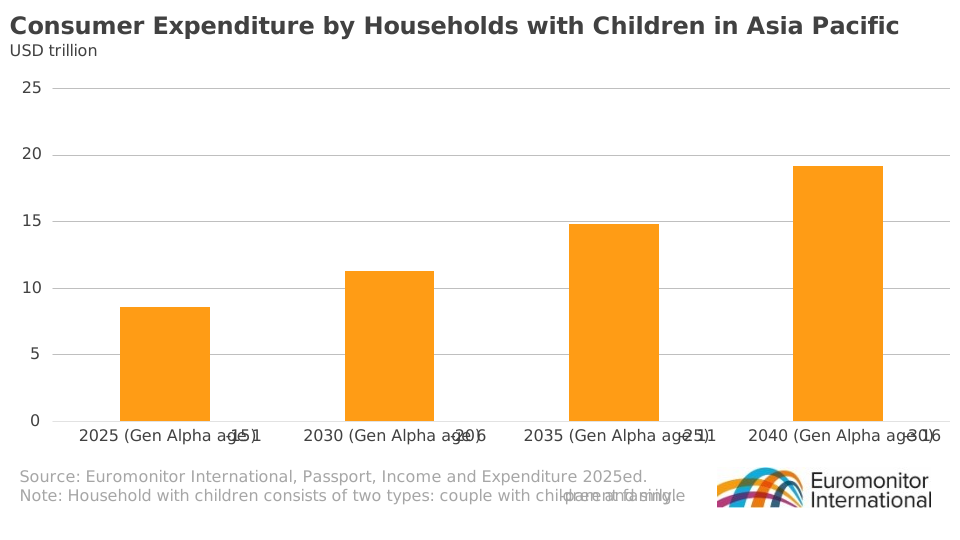
AI: Intelligent systems reshaping daily choices and autonomy
AI is becoming the central decision engine for modern Asian families. Gen AI now compresses the journey from question to answer, turning overwhelming information into clear and relevant guidance. Parents use it to compare nutritional implications. In travel planning, it aligns itineraries with trusted reviews. According to Euromonitor’s Voice of the Consumer: Lifestyles Survey, fielded January to February 2025 (n=3,927 Asia Pacific parents with children aged 0-17), 55% of Asian parents leverage Gen AI to seek information or recommendations in 2025, the second highest globally.
A deeper leap follows as agentic AI starts completing tasks with Gen Alpha and families’ pre-set criteria. Groceries are replenished based on dietary rules. Transport is arranged around predictable routines. Payments flow seamlessly across shopping, mobility and services.
These gains require careful governance. Overreliance risks weakening deeper thinking and resilience among children. Rising expectations for privacy make clear, age-appropriate consent essential for maintaining trust.
Social media and gamification compressed attention, instant gratification, higher responsibility
Gen Alpha experiences content in seconds rather than minutes. Short video formats now compress discovery, evaluation and purchase into a single gesture. Children watch educational clips and creator advice that instantly influence preferences. Brands must express value instantly, sustain relevance with personalised content that adapts smoothly to age, culture and location.
40% of Asian parents purchased from a social media platform in 2025, the highest globally.
Source: Euromonitor Voice of the Consumer: Lifestyles Survey, fielded January to February 2025 (n=4,840 Asia Pacific parents with children aged 0-17)
Gamification strengthens this impact when anchored in meaningful progression. Children respond to immediate feedback loops, and visible improvements. Parents appreciate tools that bring structure to learning, household routines and financial habits.
Yet these mechanisms can weaken wellbeing when poorly governed. Social platforms may intensify addictive behaviour while reducing face-to-face interaction. Gamified systems can encourage surface-level learning and impulse-driven consumption. The most effective response is to design phygital experiences that reward real-world action and restore balance.
Smart devices: Gateways to safer autonomy
Smartphones, smartwatches and smart appliances now shape how Gen Alpha learn, move, communicate and make decisions. Different from Gen Z, Gen Alpha’s first digital entry point is a smartphone or smartwatch, rather than a laptop. These devices underpin essential routines, from contactless payments to real-time communication with guardians during solo ride hailing and smart cooking. According to Euromonitor’s Voice of the Consumer: Lifestyles Survey, fielded January to February 2024 (n=5,129 Asia Pacific parents with children aged 0-17), 76% of Asian children had usage of a phone/smartphone in 2024, the second highest globally.
Trade-offs remain. Heavy device use can displace human connection. Frictionless payments may weaken cash literacy and value-awareness. Expanding data trails require stronger authentication and consent structures. Enforcing control mechanisms of age and time helps families and schools preserve attention, maintain boundaries and build trust.
Key takeaway
To serve Gen Alpha well, technology must feel more human and supportive. Families will prefer systems that build intrinsic motivation, empathy and healthy routines, not constant stimulation. Flexibility matters as tastes shift quickly. Modular design and fast testing cycles will help brands stay relevant.
Success will come from serving both Gen Alpha and their parents. Companies must reflect Asian expectations for convenience, transparency and health-focused benefits. The strongest platforms will bridge online and offline experiences and turn small daily actions into long-lasting positive habits.
For more in-depth insight, please read our strategy briefing, Decoding Gen Alpha as Asia’s Next Growth Engine.