
To accompany Country & Town House’s annual Great British Brands publication, GBB Live 2026, titled New Frontiers, launched in April 2026 as the inaugural event alongside the publication. Hosted at London’s iconic Town Hall by Bottaccio, the summit brought together leaders across British luxury, media, design and culture to explore the future of the sector, from AI and sustainability to shifting consumer behaviour, global expansion and modern British identity.
I had the privilege of joining the “East vs West” panel, a timely discussion hosted by John Arlidge alongside fellow panellists, Kiki McDonough and Dr R. Sri Ram.
The discussion reflected on how British luxury is evolving amid an increasingly complex global landscape. Set against the backdrop of the slowest five-year period of global economic growth in decades, the conversation was grounded in a clear reality: the luxury industry is entering a period of recalibration.
While inflation has slowed, consumer confidence remains fragile, with 71% of global consumers still concerned about the cost of everyday essentials
Source: Euromonitor Voice of the Consumer: Lifestyles Survey, fielded January to February 2026
At the same time, luxury brands face rising production costs, geopolitical uncertainty, and softer demand in key markets such as the US and China. Ongoing tensions in the Middle East further underscored the fragility of the outlook, reinforcing the sense that luxury brands are navigating an increasingly volatile environment. The result is a fundamental redefinition of value.
Across the day’s programme, a consistent theme emerged: consumption is becoming more intentional. Consumers are buying less but buying better. They are prioritising quality, circularity, and long-term value over quantity. Experiences, wellbeing and emotional connection are increasingly displacing volume-led consumption. Luxury today is less about ownership and more about meaning, longevity and relevance.
This shift was reflected in the “East vs West” discussion, which explored changing growth dynamics across global markets. While China remains critical, it is becoming more competitive and increasingly experience-driven. India, by contrast, presents a significant long-term opportunity, fuelled by a young, aspirational consumer base, while the US and Middle East continue to demonstrate resilience. Success is no longer defined by scale alone, but by cultural understanding, localisation and genuine in-market relevance.
More broadly, the day reinforced the message that the most successful brands now operate with “one foot in the past and one in the future” by balancing heritage with innovation. Technology, including AI, is an enabler rather than a differentiator. Instead, creativity, craftsmanship and human connection are emerging as the true drivers of value.
This sentiment was captured powerfully in a closing conversation with Mary Portas, who emphasised that the future of luxury lies in creativity, trust and emotional resonance. In an increasingly digital world, it is not technology but storytelling, identity and experience that build lasting brand equity.
In this context, Great British brands feel particularly well positioned. As the market shifts towards more conscious, value-driven consumption, their core strengths, namely heritage, craftsmanship and narrative depth, align closely with evolving consumer expectations. Across both mature markets such as the US and more volatile ones like China, we are seeing a clear transition away from volume growth towards experience, lifestyle integration and emotional engagement. Indeed, more than 55% of consumers prioritise spending on experiences, with 22% planning to increase spending on novel experiences in 2026. Ownership is no longer the ultimate marker of status; emotional connection and ethical alignment now define modern prestige.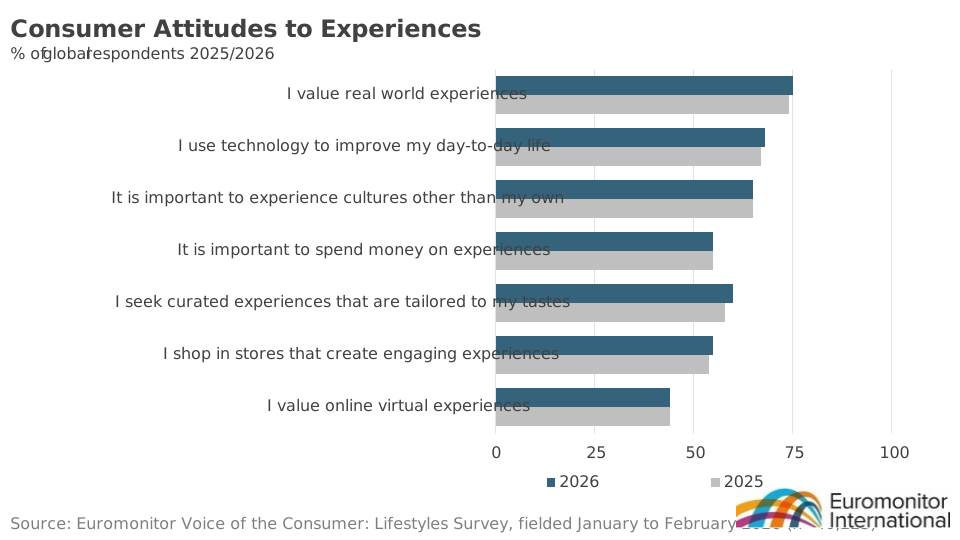
The event concluded with drinks hosted by English sparkling wine producer, Wiston Estate, a fitting expression of contemporary British luxury. Blending centuries of land stewardship with modern craftsmanship and sustainable regenerative viticulture and farming practices across the estate, the Goring family’s estate, established in 1743, produces award-winning wines using traditional methods on the historic chalk soils of the South Downs. It stands as a compelling example of how heritage, provenance, sustainability and community continue to shape the next chapter of British luxury.
Ultimately, British luxury is no longer defined solely by what it produces, but by what it stands for: quality over quantity, storytelling over status, and longevity over immediacy. In a market undergoing reset and rebalancing, the GBB Live event delivered a decisive message: Great British brands are positioned not merely to adapt, but to lead.
Want to stay ahead in the luxury market? Discover the Top Five Trends in Luxury Goods shaping consumer preferences and brand strategies this year.