
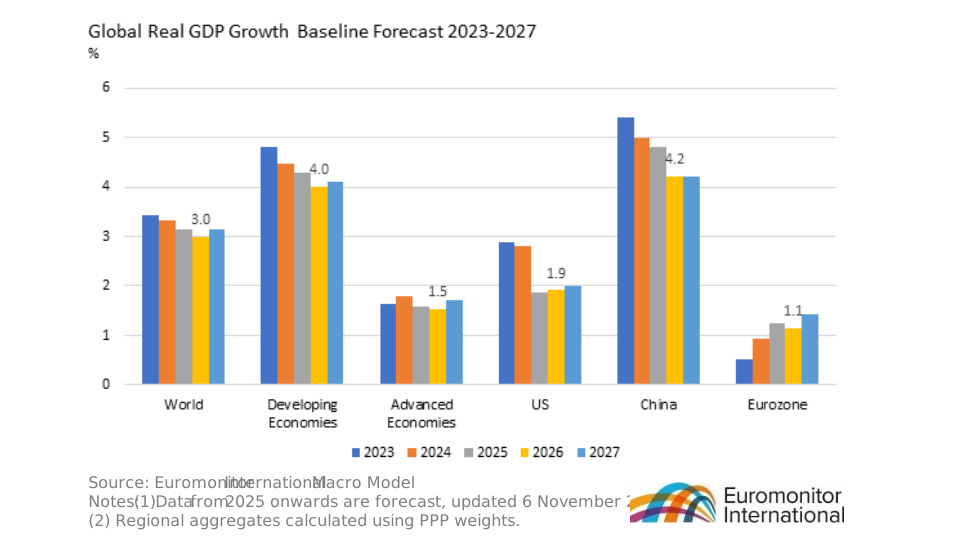
The global economy continues to adapt to the changing trade landscape, and is demonstrating resilience, on the back of lower interest rates, easing inflation, a speedy reorganisation of global supply chains and the negotiation of trade deals between the US and its key trading partners. Nevertheless, higher tariff levels and ongoing policy uncertainty cloud the outlook. In Euromonitor International’s Q4 baseline forecasts, global real GDP growth is predicted to slow to 3.1% in 2025 and 3.0% in 2026.
Risks to the global growth outlook have moderated, as uncertainty around US trade policy eases, following the closure of several trade deals and the extension of the US-China trade truce for a year until November 2026. However, risks remain tied to the downside amid geoeconomic rivalries, climate disruptions and high debt levels.
Advanced economies show resilience amid trade deals and agile supply chains, but face slower growth ahead
Advanced economies are expected to achieve 1.6% growth in 2025, moderating to 1.5% in 2026. Performance has been more resilient than expected, reflecting not only the successful completion of several trade agreements but also the private sector’s agility in rerouting trade flows. However, the outlook for 2026 is constrained by high tariffs and ongoing uncertainty, which continue to weigh on business and consumer confidence.
Although remaining stronger than previously expected, US economic growth slowed down in 2025, to 1.9%, and is predicted to maintain the same growth rate in 2026. Uncertainty regarding tariff policy, together with restrictive monetary policy, has weighed on growth, although resilient consumer spending and steady business investment helped to cushion the impact. The country’s prolonged government shutdown and further trade escalations are the risks that could dampen the outlook for 2026.
Emerging and developing markets show strength broadly, but trade barriers are headwinds
Real GDP growth in developing and emerging economies is projected at 4.0% in 2026, slightly lower than in 2025.
After a better than expected performance in 2025, China’s real GDP growth is predicted to slow down to 4.2% in 2026, as domestic and external demand weakens
Source: Euromonitor International
China’s official Manufacturing Purchasing Managers Index (PMI) dropped to 49 in October 2025, the lowest level since April 2025, pointing towards weakening factory activity.
India will remain among the fastest growing economies in the world in 2026, led by robust private consumption and public investment. The economy is predicted to grow at a slower pace, however, as commodity volatility and higher US tariffs pose risks to exports and businesses’ margins. In Brazil, growth is also expected to soften to 1.8% in 2026, amid weakening external demand and a 50% US tariff on imports from Brazil.
Global inflation moderates further, with some variation across key markets
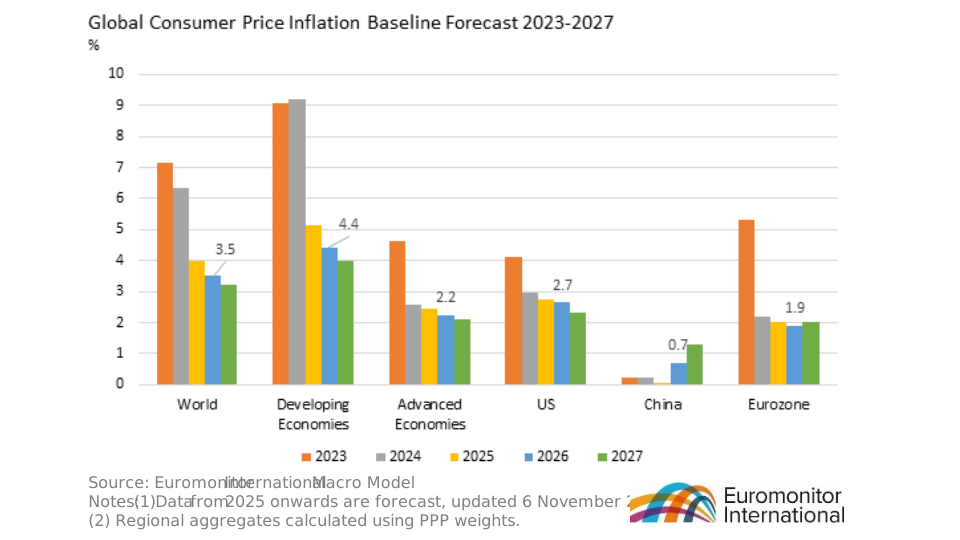
The impact of tariffs and supply chain realignment on inflation has been limited so far, thanks to front-loaded shipments and trade rerouting. Global consumer price inflation is forecast to decline further to 3.5% in 2026, from an estimated rate of 4.0% in 2025, supported by lower energy prices as economic activity weakens. Inflation continues to diverge across key economies.
In the US, inflation has edged up slightly since H2 2025, as services inflation has remained elevated, import duties have increased, and front-loading of inventories runs its course. US annual average inflation is expected to stay rather elevated at 2.7-2.8% in 2025-2026. Meanwhile, Eurozone headline inflation is approaching the ECB’s 2% target, mainly supported by lower energy costs. In China, overcapacity issues and weak domestic demand will continue to exert deflationary pressures, with annual inflation expected to stand at 0.7% in 2026.
For more insights about the global economic outlook, attend our webinar, Economic Outlook for 2026, and read our full report, Global Economic Forecasts: Q4 2025.