
K-beauty’s global trajectory has entered a new chapter. Once dominated by China, the export landscape has shifted dramatically, with the US now commanding over half of total sales. K-beauty 1.0, spanning roughly 2011-2018, highlighted Korean skin care routines and innovative items like BB cream. In contrast, K-beauty 2.0, emerging from 2020, emphasises advanced technology, stronger global branding, and mid-range products that deliver high quality at accessible prices.
This article is based on Euromonitor E-Commerce data through to Q2 2025. Download the full-version white paper here, with the most updated Q3 2025 E-Commerce data.
The market reversal from China to the US
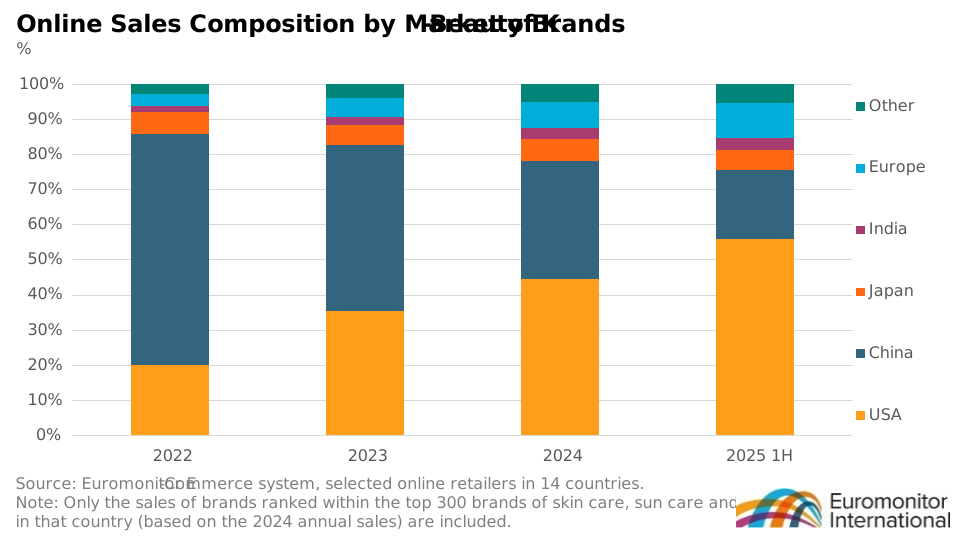
The US has overtaken China as the top export destination for K-beauty, accounting for 55% of total K-beauty’s overseas online sales in the first half-year of 2025, up from 20% in 2022, according to Euromonitor’s E-Commerce system. China’s share has dropped from 66% to 20%, driven by intensified competition from domestic C-beauty brands and a cooling of Chinese consumer sentiment towards Korean brands.
K-beauty brands are pursuing a deliberate “branch out from China” strategy
Source: Euromonitor International
Penetration hotspots: The US, Japan, Australia
K-beauty’s penetration varies by market and category, with skin care and sun care consistently outperforming colour cosmetics, except in China and Japan. The US, Japan, and Australia have emerged as the top penetration hotspots. In the US, 35 of the top 300 skin care or sun care brands were K-beauty brands in 2024. Brands such as COSRX, Laneige, Anua, and Beauty of Joseon are winning consumers over with their lightweight textures, functional innovation, and soft power of Korean cultural influence through digital media.
K-beauty’s global momentum is driven by a cohort of high-performing brands. Euromonitor’s E-Commerce system tracks brands’ online sales of selected online retailers in 14 countries. According to this system, in 2024, five K-beauty brands surpassed USD100 million in annual sales, while 24 brands generated USD20-100 million, and 58 brands generated USD1-20 million.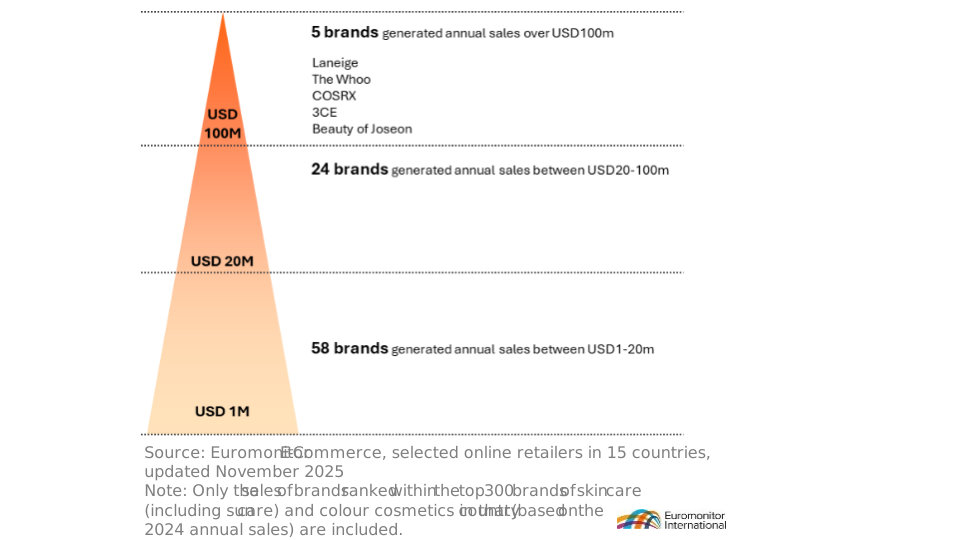
What’s next for K-beauty? Innovation and tariff challenges in the US
South Korea’s reputation for advanced aesthetic procedures is shaping the next wave of K-beauty innovation. Ingredients once reserved for clinical treatments, such as PDRN and exosomes, are now entering mainstream skin care, driving premium product development. At the same time, the “skinification” trend is extending to hair care, with scalp health emerging as a growth category. Brands like Dr. Groot are leading with targeted solutions such as scalp tonics and exfoliating scrubs.
However, K-beauty faces mounting pressure from US tariff policies. The US remains the largest export market, and the potential termination of the free trade agreement in Q2 2025 triggered consumer concerns over rising prices. Higher costs could erode one of K-beauty’s key advantages: affordability, potentially weakening brand loyalty.
To mitigate these risks, two strategic levers stand out: geographic diversification and premiumisation. Southeast Asia and Latin America offer high growth opportunities to complement the US exposure. Europe is gaining traction as a strategic region, with Western and Central Europe experiencing rapid growth in demand for K-beauty, while the concept is still being introduced to Eastern Europe. Meanwhile, moving upmarket allows brands to command higher price points, creating margin flexibility to absorb tariff shocks. Premiumisation not only strengthens brand equity but also enhances financial resilience against policy volatility.
Download the full-version of The Rise of K-beauty white paper here.
Read more of our publications on K-beauty and the Asian beauty market: