
The 2026 Consumer Electronics Show (CES) concluded with AI still front and centre. Amidst a turbulent couple of years for the tech industry, there is a notable shift in product line-ups and offerings showcased by large players; more services and integrations pick up where CES 2025 left off, raising questions of privacy and ownership that firms are aware of, yet cautious to answer.
AMD and Nvidia recognise their own need for vast amounts of computing power, as they seek to bring 2025’s buzzwords “physical” and “agentic” AI into consumers’ hands, along with this year’s “edge” AI. Rather than a focus on tangible consumer-spec GPUs and processors, a shift into a centralised, service-based pay model is materialising.
AI gigafactories: Beyond manufacturing
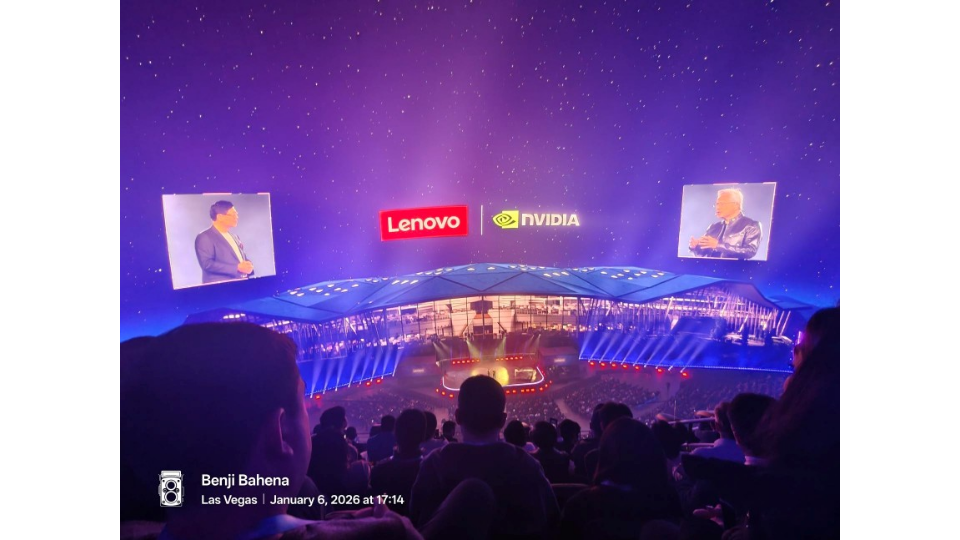
Historically, Nvidia and AMD have used CES to launch upgraded product lines. For many consumers, these firms are synonymous with GeForce and Radeon graphics cards, while AMD also supplies Ryzen processors. At CES 2026, however, their focus had shifted from on- and in-device features to a more centralised approach for increasing both consumers’ and enterprise-level processing power. Nvidia, which almost monopolises graphics cards, had no new consumer GPU to announce. Rather than focusing on the apparent bottlenecking of supply, it presented advances in the physical and edge AI world.
Wearables and their discontents
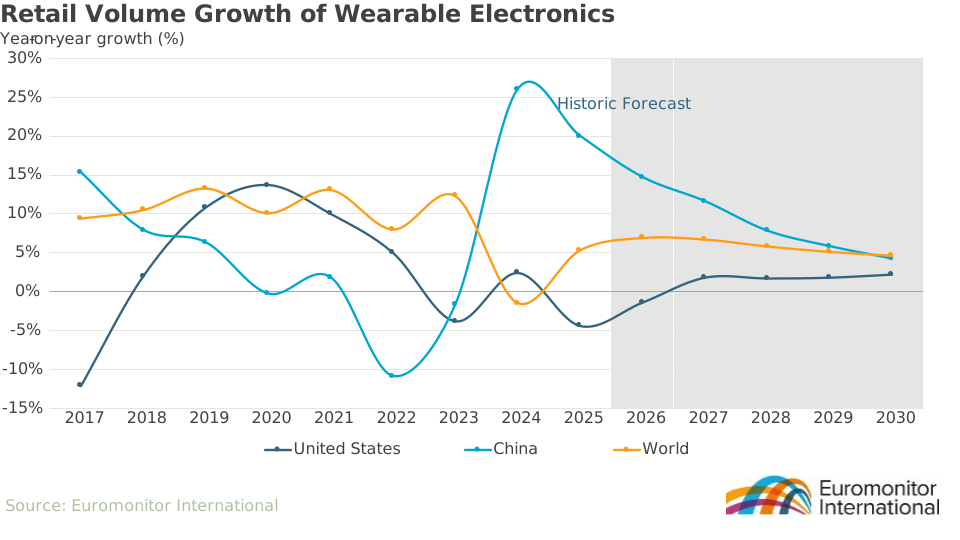
What could the consumer look to? AI integration-enabled wearables dominated stage time throughout CES with firms showcasing everything from TWS headphones and open-earbuds to health-tech smart rings. Wearable electronics is forecast to grow at a steady 5% year-on-year to 2030, amidst a disrupted consumer electronics industry afflicted by lowered expendable income, tariff disruptions, and inflated costs due to AI’s insatiable resource draw.
Another Lenovo partnership, with Qualcomm, exemplifies the industry’s approach. Integrating a newly-launched AI agent named Qira, Lenovo’s proof-of-concept necklace pin, glasses, laptop, and phone system seek to streamline your day-to-day behaviours, messaging patterns, and even memory creation via autonomous recording and picture taking, into an automated flow that creates a “digital twin” that “thinks” like you (imitates the patterns you give Qira access to). “With your permission, of course” was a phrase punctuating the presentation, flagging the possible concerns with the creation of so intimate a record of one’s behaviour.
On services and the future of ownership
The services offered by Qira, Lenovo and any firm seeking to imitate the apparent model proposed by the state of AI will require increasing amounts of faster compute as adoption increases. A prediction from CES held that “within 3 years 80% of the PC market would be Ai PCs”. As centralisation of the resources which enable AI seems to be the way forward, a focus shift towards services and AI enablement appears to be imminent, mirroring shifts in streaming that pushed aside physical media in favour of Netflix and Spotify. The question of ownership arises, particularly for data and computing power, as even the right to repair has been in and out of US and European courts recently. Whichever way the pendulum swings, the tech world is in the middle of quite the shift.
Free trade is breaking down in the wake of Trump’s protectionist policies. Wearables is predicted to grow just as Chinese brands (eg Xiaomi, Huawei) make up a significant portion of popular subsectors such as activity wearables. Closing the de minimis exemption leaves the industry shaken. Find out more about the wearables market’s own need to pivot in our Future of Wearables Briefing.