AustralasiaEuromonitor publishes comprehensive data and analysis with five-year forecasts on products, industries, demographics and consumer lifestyles in Australasia.
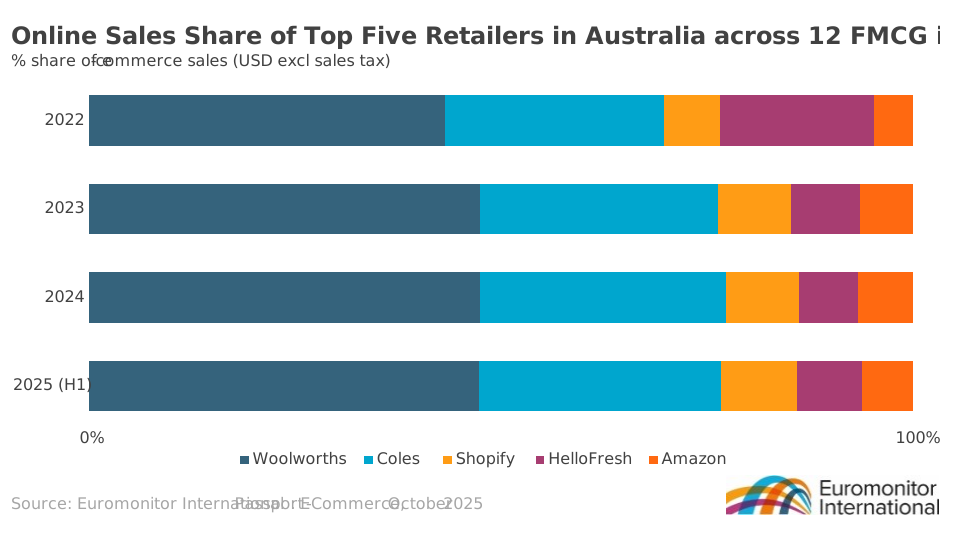
Since its 2017 entry into the Australian market, Amazon has transformed the country’s e-commerce landscape. The marketplace giant has established a growing presence in convenience-driven fast-moving consumer goods (FMCG) categories. According to Euromonitor’s proprietary Passport: E-Commerce system, which tracks over 205,000 brands globally across 12 FMCG industries, Amazon currently accounts for about 5% of Australia’s e-commerce sales in the FMCG space, notably gaining ground in categories with frequent replenishment and low brand loyalty, such as home care, tissue and hygiene, and select personal care segments.
Market share shifts in Australian FMCG e-commerce
Beauty and personal care is the largest e-commerce segment, by sales, in the FMCG space, according to Euromonitor’s E-Commerce system. Driven by rich content, frequent replenishment cycles, and influencer-driven marketing, the category remains at the forefront of digital disruption. Traditionally dominated by retailers like Woolworths, Coles, Chemist Warehouse, and Adore Beauty, in Australia global platforms like Amazon and Shopify are reshaping the competitive landscape.
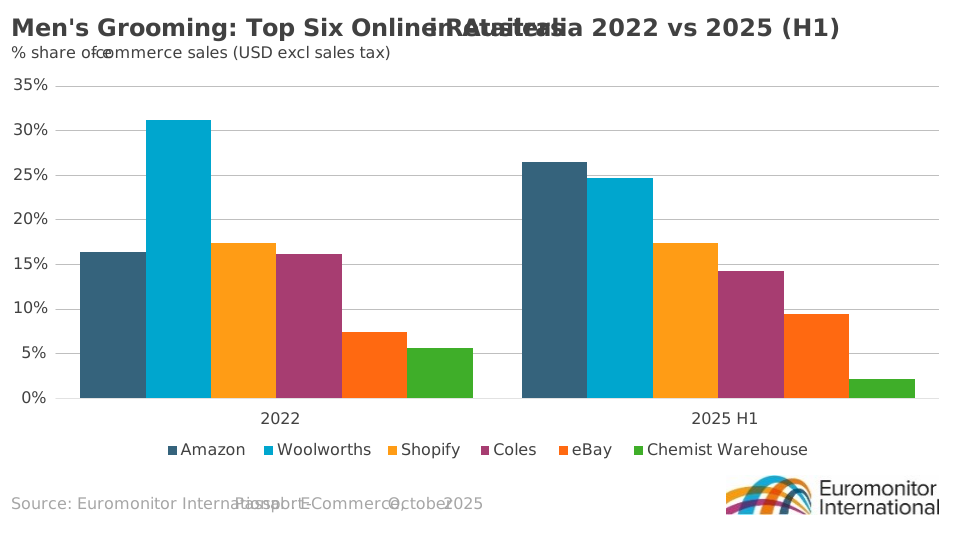
Amazon’s share gains are most evident in categories such as baby and child-specific products, bath and shower, deodorants, depilatories, fragrances, oral care, and men’s grooming. For example, Amazon now leads in online sales of oral care in Australia, with a 38% share of the market in the third quarter of 2025, driven by power toothbrushes, while Woolworths accounts for 25%, leading across toothpaste, manual brushes, floss, and adjacent products. In men’s grooming, Amazon has held the top spot since 2023, thanks to its high share of sales of razors and blades. These categories, once considered in-store essentials, are shifting online as Amazon leverages fast delivery, curated storefronts, and subscription models.As Amazon grows and the market becomes crowded and competitive, differentiation is becoming key. This is giving rise to the importance of strengthening the direct-to-consumer (DTC) channel. Shopify, in particular, has lowered the barriers for brands to enter the DTC channel – a rapidly evolving space – while premium beauty is likely to remain controlled more by beauty specialist retailers such as Mecca and Sephora.
Amazon erodes supermarket dominance in home care and tissue
Categories with frequent replenishment and low brand loyalty, such as tissue and hygiene and home care, are proving particularly vulnerable to Amazon’s convenience-led proposition. In online laundry care sales, Amazon’s gains have almost perfectly mirrored Woolworths’ losses, lifting its share from 6% in 2022 to more than 10% during the first nine months of 2025. A similar trend is evident in surface care, where Amazon has nearly doubled its share since 2022, while Woolworths and Coles together have fallen from 79% to 70%. This pattern highlights how Amazon is steadily eroding the dominance of the Australian supermarket giants in the digital FMCG space by capturing repeat, need-based purchases. Free and faster delivery options, like same-day or next-day for Prime members, are raising consumer expectations and reinforcing Amazon’s position in convenience-driven categories.
Market evolution and local response
The evolving competitive landscape has forced local retailers to accelerate their digital transformation. Coles and Woolworths have both invested in automated distribution and fulfilment centres to facilitate e-commerce sales. Investments in delivery speed, curated product ranges, and digital experiences are also essential for maintaining relevance and defending market share.
Other local retailers, including Chemist Warehouse and Bunnings, have also developed online marketplaces, allowing third-party sellers to list and sell products, thereby broadening their assortments beyond core portfolios. However, Amazon’s scale and infrastructure, such as the recent investment of over AUD30 million in next-generation delivery station technology across the country, continue to set a high bar for operational efficiency and customer convenience.
Amazon’s recent Australian initiatives – such as the August 2025 launch of Amazon Haul, an app-based shopping feature offering hundreds of thousands of products for less than AUD25, and the April 2025 launch of Amazon Beauty Finds, a curated storefront for value skin care, hair care, beauty tools, and appliances – further demonstrate the retailer’s intent to expand in both value and high-touch categories.
Australia’s e-commerce landscape is entering a new phase of digital innovation – and Amazon’s steady gains in convenience-driven categories are reshaping consumer expectations and competitive strategies.
To learn more about brands winning in digital commerce and their strategies, read our white paper, Top 100 FMCG brands in e-commerce.
New manufacturing hubs are driving supply chain diversification efforts. However, these countries still depend on imports of Chinese components, making supply…
Connected and autonomous vehicles are becoming more widespread, reflecting the automotive industry's digital and technological shift. This report sizes the…
Fragrances are gaining relevance among consumers experiencing anxiety and looking for emotional wellness. Fragrances, however, face many challenges, as they…