
Sustainability has shifted from an optional extra to a meaningful source of growth, resilience and trust. Leading brands are responding by reshaping how they design, source and communicate.
Between 2020 and 2024, sustainable products expanded at a 7.8% CAGR, outpacing conventional ones by 2.4 percentage points, crossing USD800 billion in value and gaining close to half of the digital shelf
Source: Euromonitor Sustainability Claims Tracker, considering 25 markets and 11 industries
They are proving impact, not just promising it, and making sustainable choices feel effortless for everyday shoppers.
In our latest report, Competitor Strategies in Sustainability, we explore further what leaders are doing differently and which strategic moves matter most for the years ahead.
Sustainability strategy increasing relevance
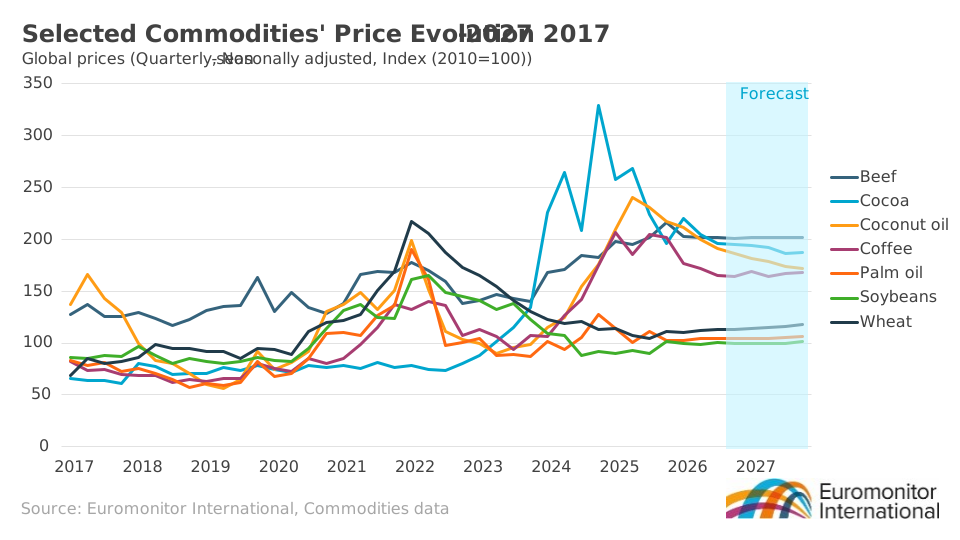
Sustainability strategies are shifting quickly because the next decade will be more volatile than the last. Climate shocks, geopolitical tension and changing regulation are already disrupting prices and supply for key commodities. Companies that rely on crops, animal products and energy-intensive production cannot assume “business as usual” will hold.
Consumer expectations are moving in the same direction. People are anxious about their health, finances and the wider world. They want brands they can trust, clear information and products that feel both responsible and good value. At the same time, spending on more sustainable lifestyles is set to keep growing, especially in emerging markets.
Internal barriers – like limited budgets or doubts about return on investment – are increasingly out of step with the evidence: across fast-moving consumer goods (FMCG), products with credible sustainability claims have already proved more resilient in turbulent times.
How leading brands turn intent into impact
Our latest research on global competitors shows that the most effective sustainability strategies share the following four pillars that compose the 4S growth strategy: they scale, have substance, tell a clear story and make life simpler for consumers.
Scale: Leaders move beyond small trials. They work with retailers, suppliers and governments to build shared infrastructure and solutions that can reach millions of shoppers.
Substance: They focus on measurable improvements, such as lower emissions, more responsible sourcing, safer working conditions and healthier formulations. Progress is tracked with clear metrics, not just high-level ambitions.
Story: Communication moves away from vague, feel‑good messages towards transparent updates on what is changing and why. The emphasis is on trajectory, where the company is heading and how that benefits people and the planet.
Simplicity: Shoppers do not have time for homework. Winning brands make the better option easy to recognise, easy to understand and not obviously more expensive.
Four areas where competitors will race ahead
Over the next few years, most FMCG players will focus their sustainability efforts on four pressure points. These are the areas most exposed to climate risk, regulation and consumer attention.
Waste and packaging: Cutting waste, boosting recycling and designing packaging that can be reused or easily processed, in line with tighter rules and rising expectations.
Energy and emissions: Improving efficiency in factories, logistics and stores while shifting towards cleaner energy to reduce both costs and exposure to carbon risk.
People and communities: Protecting workers’ rights, supporting local communities and improving safety and wellbeing across the value chain.
Responsible sourcing: Working more closely with farmers and suppliers to avoid deforestation, protect water resources and secure long‑term access to raw materials.
Consumers increasingly expect trustworthy, natural‑leaning products, and they want proof that these come from responsible systems, not just attractive labels.
Turning sustainability into everyday advantage
Sustainability is now central to how brands grow, protect supply and maintain trust in a more volatile world. Behind the headlines, the real shift is from isolated initiatives to integrated, scalable systems that support both performance and purpose.
Read our full report, Competitor Strategies in Sustainability, to explore detailed brand-level data, regional differences and relevant case studies on how leading players and retailers are implementing sustainability strategies for growth.