
Industrial unmanned aerial vehicles (UAVs) are entering a transformative era. The global market is accelerating towards electric vertical take-off and landing (eVTOL) systems, reshaping operational models and industry priorities. This shift is significant and urgent, influencing logistics, safety, and infrastructure strategies worldwide.
Market growth highlights industrial UAVs as a critical growth engine
The global aircraft and spacecraft market exceeded USD 800 billion in production value in 2025, with a 9% CAGR since 2020. Driven by industrial UAVs, a 5% CAGR is projected for 2025-2030, to exceed USD 1 trillion.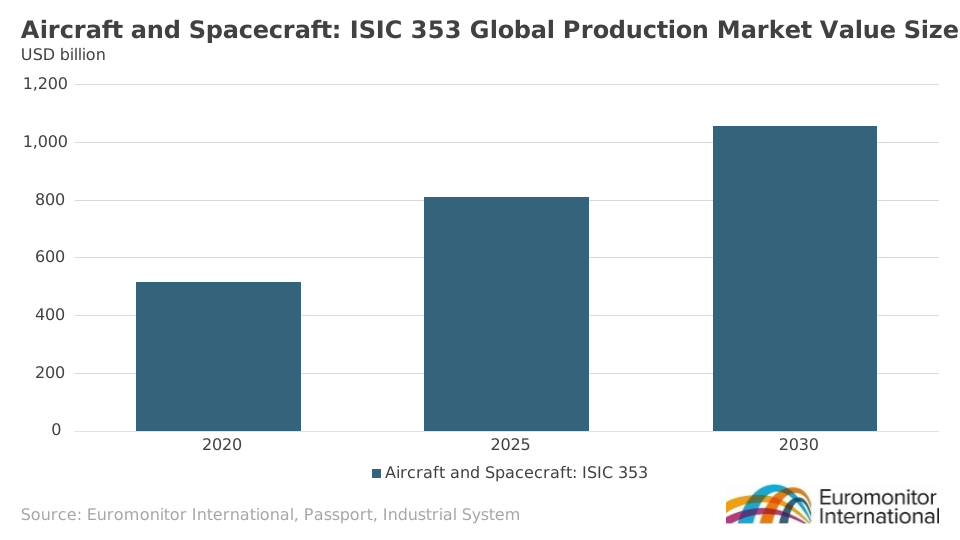
Among them, industrial UAVs saw double-digit volume growth in 2023-2024, driven by adoption across logistics, emergency response, and infrastructure inspection. This growth positions UAVs as a cornerstone of next-generation aerial mobility.
China’s 89% share of 2024 global medium (25-150kg maximum take-off weight (MTOW)) UAV exports underscores its vertically-integrated manufacturing strength and its strategic push to dominate the low‑altitude economy. Full control of batteries, materials and avionics enables unmatched scale for agricultural and industrial deployment.
In contrast, the Netherlands, Hungary and the US command 68% of large (150kg+ MTOW) UAV exports, each leveraging niche advantages: Dutch maritime‑logistics VTOL engineering, Hungarian aerospace capabilities, and US leadership in sensor fusion and AI‑autonomous mission systems.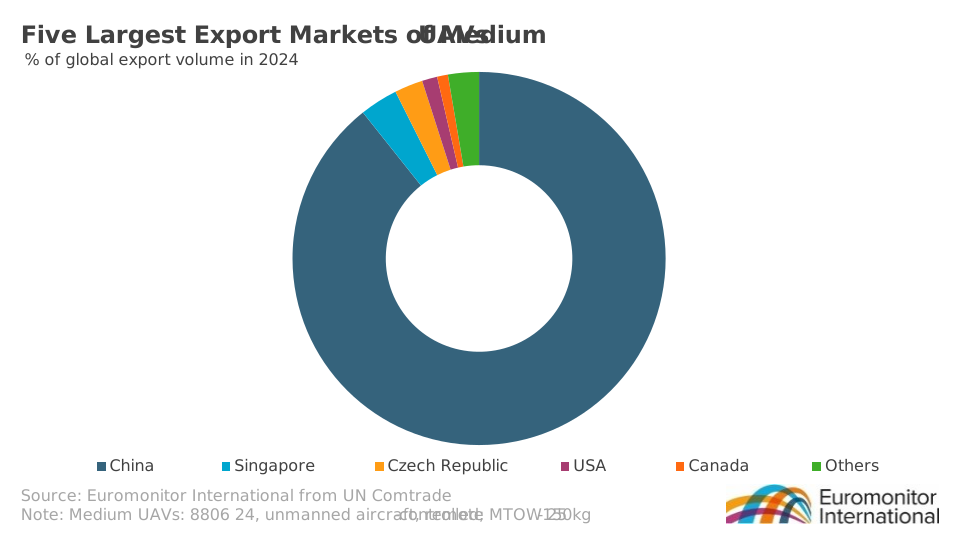
Electric propulsion and rotary-wing dominance define future UAV trajectory
In 2020-2025, electric powertrains gained significant share, supported by sustainability and cost efficiency, while internal combustion engine (ICE) models declined. Hybrid systems remain transitional. Structurally, rotary-wing designs outperform fixed-wing models due to VTOL capability, essential for urban environments. By 2030, electric rotary-wing UAVs, particularly eVTOL models, will dominate in volume and value. China, the US, and Western Europe are the largest eVTOL markets, leveraging infrastructure and regulatory progress.
Category shares underscore this trend: electric powertrains accounted for 28% of industrial UAV volume in 2020 and 46% in 2025, projected to exceed 65% by 2030. Rotary-wing designs represented 52% of volume in 2020 and 68% in 2025, expected to surpass 80% by 2030. Electric rotary-wing UAVs alone are forecast to capture over 50% of total category value by 2030.
Beyond 2030, solid-state batteries and autonomous navigation will extend range and safety. Integration with smart city ecosystems and AI-driven traffic management will position eVTOLs as a backbone of urban mobility, creating new revenue streams and partnerships.
Competitive dynamics reveal fragmentation and opportunities for agile innovators
Airbus and Boeing maintain a combined 22% value share of aircraft and spacecraft in 2024
Source: Euromonitor International, Passport, Industrial System
However, industrial eVTOL competition is more fragmented. Global innovators such as Joby Aviation, Vertical Aerospace, EHang, AutoFlight, DJI and TCab Tech are shaping the category. Strengths include advanced R&D and integrated supply chains; weaknesses persist in regulatory compliance and aftermarket services, allowing agile entrants to differentiate through certification readiness and customer-focused models.
Future competition will hinge on predictive maintenance, software integration, and modular battery systems. Companies investing in AI-driven diagnostics and ecosystem partnerships will secure long-term leadership.
Cost-efficiency and diverse applications accelerate global eVTOL adoption
Declining purchase prices and lower operating costs compared with internal combustion models enhance affordability. Battery innovation extends range, addressing a key barrier to scale. These factors position eVTOL as a practical solution for multiple industrial applications. Public safety, disaster response, and emergency services benefit from rapid deployment capabilities. Infrastructure inspection and precision agriculture showcase efficiency gains through real-time data collection. Industrial logistics and cargo transport represent another high-growth area, reducing reliance on ground networks and improving supply chain resilience.
By 2035, integration with renewable energy grids and automated charging stations will further reduce lifecycle costs, enabling near-zero emissions and minimal downtime.
Closing structural gaps remains critical for sustainable international expansion
Despite strong momentum, challenges remain: uneven charging infrastructure development, disharmonised regulatory standards, and fragmented aftermarket services. Limited insight into channel dynamics and high costs for SMEs further constrain adoption. Progress requires coordinated regulatory frameworks, expanded charging networks, and standardised second-hand sales channels. Enhanced market intelligence and user research will optimise distribution strategies and strengthen customer engagement, paving the way for a globally integrated eVTOL ecosystem.
Long-term success will depend on collaboration among governments, manufacturers, and technology providers to create interoperable standards and scalable infrastructure solutions.
Foresight and strategic alignment will define industry leadership
Industrial UAVs are central to the future of global transport and operational resilience. The transition to eVTOL technology is more than a technical upgrade; it is a strategic imperative. Companies that anticipate regulatory shifts, invest in infrastructure, and prioritise customer insight will lead the next era of aerial mobility, shaping a market defined by efficiency, sustainability, and adaptability.
For more analysis of industrial trends, please read Top Five Industrial Trends.