
In a previous ingredients article, we examined the fastest-growing botanical ingredients using Euromonitor’s AI-led Ingredients Dashboard to identify the categories and geographies responsible for that rising demand. While this helps establish where ingredient momentum is building, ingredient companies also need deeper visibility into how these ingredients are being used, and which beauty and personal care players are translating that demand into scalable product applications.
In this piece, we turn to one of the most searched and strategically important ingredients in beauty and personal care: salicylic acid.
Top beauty companies anchor global demand
In 2025, salicylic acid was the fourth largest conditioning agent captured in Euromonitor’s Ingredients Dashboard, following vitamin B3, hyaluronic acid and allantoin
Source: Euromonitor’s Ingredients Dashboard
Its concentration within skin care and hair care products shows that it has moved beyond acne-focused formats to become a core functional ingredient used for exfoliation, pore and sebum control, scalp care and texture refinement across everyday formats.
For ingredient manufacturers, this variety of functional benefits and consumers’ increasing awareness (it was the most searched skin care ingredient of 2024 according to digital marketing agency Foundation) make it essential to understand not only how widely salicylic acid is used, but which beauty and personal care (BPC) companies are generating most of that usage. Tracking adoption at the demand level clarifies where formulation strategies are shifting, which players are driving that momentum and where future partnership opportunities are most likely to emerge as the ingredient continues to scale across global portfolios.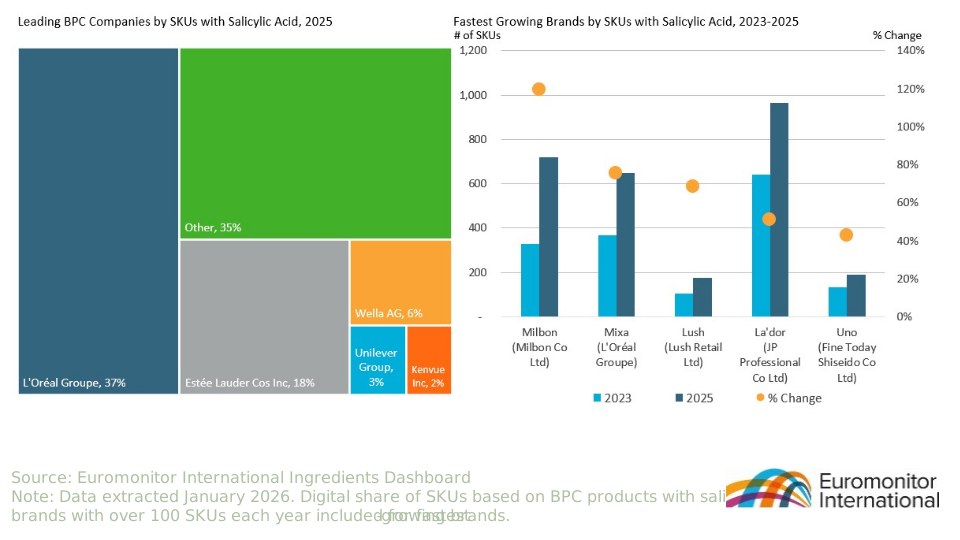
The Ingredients Dashboard data shows that salicylic acid usage is highly concentrated among a small group of global players, led by L’Oréal, followed by Estée Lauder, Wella, Unilever and Kenvue. For ingredient suppliers, understanding how these companies deploy salicylic acid across their portfolios is key, since shifts in their formulation strategies often shape broader market adoption.
At the same time, some of the fastest increases in salicylic acid usage are coming from a different set of players that have been expanding their portfolios at a rapid pace. Brands like Milbon, La’dor, Uno, Mixa and Lush have incorporated salicylic acid into a growing number of SKUs, signalling where innovation momentum is building and where future demand may strengthen. For ingredient players, tracking both the dominant companies and the high growth brands provides early insight into evolving use cases and formulation priorities, especially as many of the fastest-growing adopters come from Asia, where interest in scalp health, sebum control and smoother skin textures continues to rise.
Positioning new launches with ingredient spotlights
This combination of company and brand data also provides a natural bridge into how salicylic acid is showing up in innovation activity, as tracked through Euromonitor’s Passport Innovation new product tracker. One recent example from the US market is the brand Starface, which expanded its portfolio in early 2025 with the launch of its Star Wash + Salicylic Acid cleanser specifically citing the “hero ingredient”. This launch helped the company move beyond its core pimple patch offering in response to broader acne care trends. It also reflects how brands are translating ingredient momentum into adjacent categories, using established actives to support portfolio expansion rather than one-off product claims.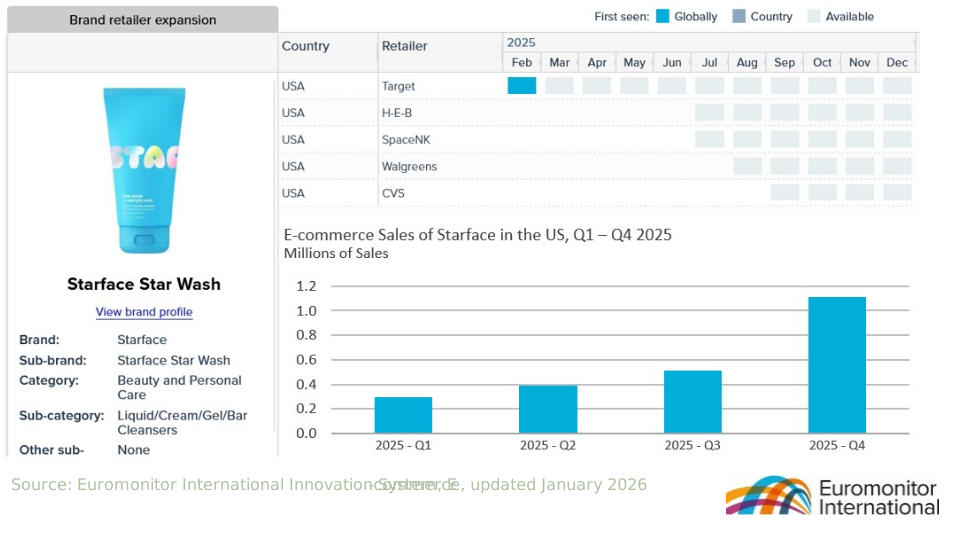
The relevance of this shift becomes clearer when viewed alongside commercial performance. Starface’s US e-commerce sales reached approximately USD1.1 million in Q4 2025, a 73% increase from Q4 2024 according to Euromonitor’s E-Commerce sales data. Together, these signals show how ingredient‑led innovation can support brand evolution and category extension, reinforcing why tracking salicylic acid usage and other hero ingredients across products, brands and innovation pipelines is increasingly important for both ingredient suppliers and beauty companies seeking to understand where future growth may emerge.
For more information on ingredients and innovation, contact us to discover where new products are expanding the fastest and what ingredients are driving growth. For more information on healthy longevity, see our report, Healthy Longevity: Maximising Opportunities Across the Lifecycle.