
As the global economy navigates slow growth, tight labour markets and ongoing geopolitical tensions, luxury consumers are becoming more selective about how and where they spend. Nevertheless, the market continues to demonstrate resilience. With January’s period of restraint now behind us, Valentine’s Day 2026 represents the first major opportunity to reignite demand, followed closely by Chinese New Year and Eid al-Fitr, which marks the end of Ramadan.
Against this backdrop, Valentine’s Day 2026 is shaping up to be a telling moment for the luxury market. More than a seasonal sales spike, it will reflect how shifting consumer values – around meaning, value, wellness and emotional connection – are redefining what “luxury gifting” looks like today.
A shift towards meaningful, experience-led gifting
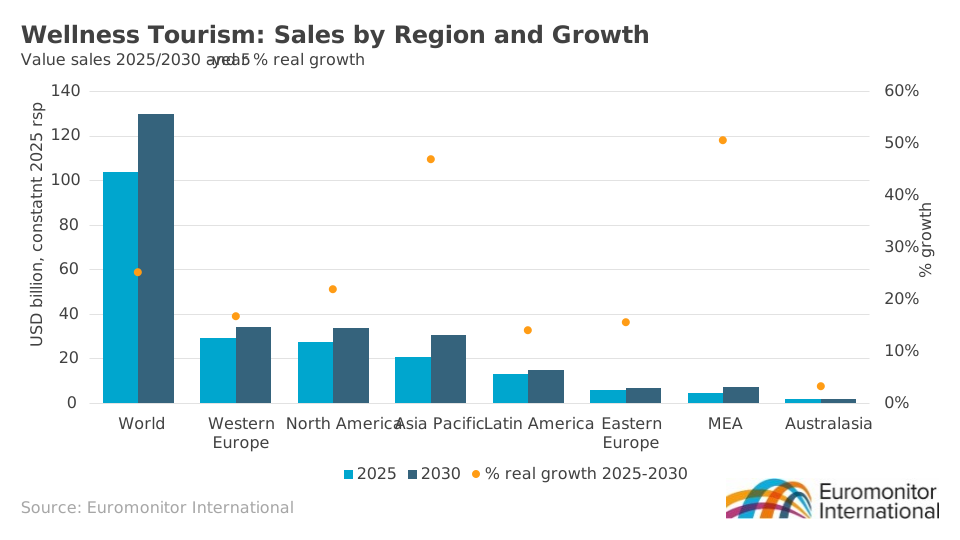
While traditional Valentine’s Day categories – fine jewellery, watches and leather goods – remain steady, consumer behaviour is shifting towards experiential luxury. High-end dining, wellness retreats, luxury travel and exclusive cultural or hospitality-led events are set to capture an increasing share of Valentine’s Day spend. This reflects a broader transformation across the luxury landscape, where emotional wellbeing, restorative escapes and “time together” have become powerful expressions of care.
Why luxury jewellery will still shine
Despite economic caution, fine jewellery remains uniquely well positioned for Valentine’s Day. Unlike luxury goods categories, where substantial price rises have weakened consumer trust, jewellery continues to be viewed as both emotionally significant and materially valuable. Its intrinsic worth – especially within gold-based categories – offers reassurance in today’s uncertain economic environment.
Consumers, particularly Gen Z, are moving away from brand-driven logos and towards symbolism, storytelling and authenticity. This is elevating demand for timeless, versatile pieces, such as pearls and signet rings – items that deliver permanence, wearability and emotional resonance.
Personalisation is at the heart of this trend. Engraved initials, zodiac symbols, celestial motifs and gender-neutral silhouettes are transforming jewellery into intimate markers of identity. As Valentine’s Day gifts, these pieces offer something increasingly rare: emotional depth without excess.
Luxury’s redefined value system
Valentine’s Day 2026 lands in an era when luxury itself is undergoing structural change. Younger consumers, in particular, are experiencing heightened anxiety and pressure, and are gravitating towards brands that deliver nourishment, purpose and authenticity – not simply aspiration.
For them, luxury is no longer just product ownership; it is emotional intelligence, wellbeing, quiet refinement and personal meaning. This shift positions both experience-driven gifts and personalised, enduring jewellery as the most compelling propositions for the season.
This Valentine’s Day, we expect brands to be rewarded for offering experiences that restore and connect people, create positive memories, provide jewellery that blends symbolism with personalisation, demonstrate authenticity and transparency, show cultural resonance, and strike the right balance between emotional significance and material value.
Indeed, in a climate of selective spending, the gifts that endure – emotionally, physically or experientially – will define luxury’s most successful stories for Valentine’s Day 2026.
To understand Gen Z and their consumption patterns and preferences, read our report, What Fashion and Luxury Brands Should Know About Gen-Zers.