
As we step into 2026, global markets face a complex landscape shaped by resilient but restrained growth, evolving trade dynamics, cost volatility, widening consumer market polarisation and the emerging influence of Generation Alpha.
The new Trump tariffs, ongoing geopolitical tensions, and persistent economic uncertainty will continue to shape business decisions worldwide. These forces were already making waves in 2025 – and their impact will only deepen this year.
The big question is what does this mean for luxury and fashion in the months ahead?
Growth outlook in luxury and fashion: Slower, but moving in the right direction
We expect growth across both fashion and luxury to remain in low single digits over the next five years. This reflects solid performance given global headwinds.
In 2025, luxury sales grew by 3%, reaching USD1.5 trillion. While discretionary spending will remain under pressure, the sector is far from decline. A similar story can be seen in fashion, albeit more subdued, with 2025 ending with growth of 2.4% in current terms, which in constant terms is a disappointing 0.1% decline (USD fixed 2025 exchange rate). Looking ahead, we expect to see subdued forecast growth with a projected CAGR of 0.8% in real terms for the apparel and footwear industry over 2025-2030. Much like luxury, geopolitical tensions, climate change and uncertainty around tariffs cloud the global economic outlook, leading to increased consumer discernment and normalised budgeting under persistent cost-of-living pressures.
One thing is clear and that is, in 2026, luxury and fashion will continue shifting from product-centric to experience-led engagements, where wellness, lifestyle and meaning matter as much as the purchase itself.
Emerging markets: The new frontier
Growth will increasingly come from emerging markets. With the US and China slowing, brands will pivot to regions with stronger momentum. Over 55% of luxury players plan to invest in these markets in the next five years. We expect this to accelerate in 2026.
That said, international trade has become harder to navigate, as political and strategic considerations increasingly overturn established rules. In response, companies are prioritising resilience and risk mitigation, moving production closer to end markets or diversifying supply chains and rethinking their expansion strategies across regions.
Redefining value
Economic uncertainty will force luxury and fashion brands to rethink what “value” means. Within the luxury space, heritage and craftsmanship remain important, but alone these are not enough while in the wider fashion industry, consumers increasingly look beyond product specifics and seek added value in the shopping experience, convenience, innovation and community-driven initiatives. The 2026 consumer now demands more – purpose, sustainability and emotional connection. We expect to see affordable luxury gaining more traction and rental, resale and repair services becoming more mainstream across luxury and fashion retailers, as affluent consumers increasingly prioritise quality over quantity and show an intention to buy less but better.
Experience as the ultimate status symbol
In 2026, status will be defined by how you live, not what you own. Experiences – travel, wellness, cultural immersion – will dominate consumer priorities.
75% of consumers say real-world experiences are extremely important and two thirds prefer spending on experiences over physical goods
Source: Euromonitor Voice of the Consumer: Lifestyles Survey, fielded January to February 2025
In this context, brands that create memorable, meaningful experiences will win. Watch for more hospitality ventures, branded cafés and lifestyle collaborations.
Wellness and longevity: The megatrend
Wellness is no longer niche – it’s a global megatrend and a status marker. Longevity will gain even more traction in 2026, driving demand for luxury hospitality, preventative health and lifestyle services. We expect major players to expand into sports, wellness tech and health-focused travel. This is where future growth lies.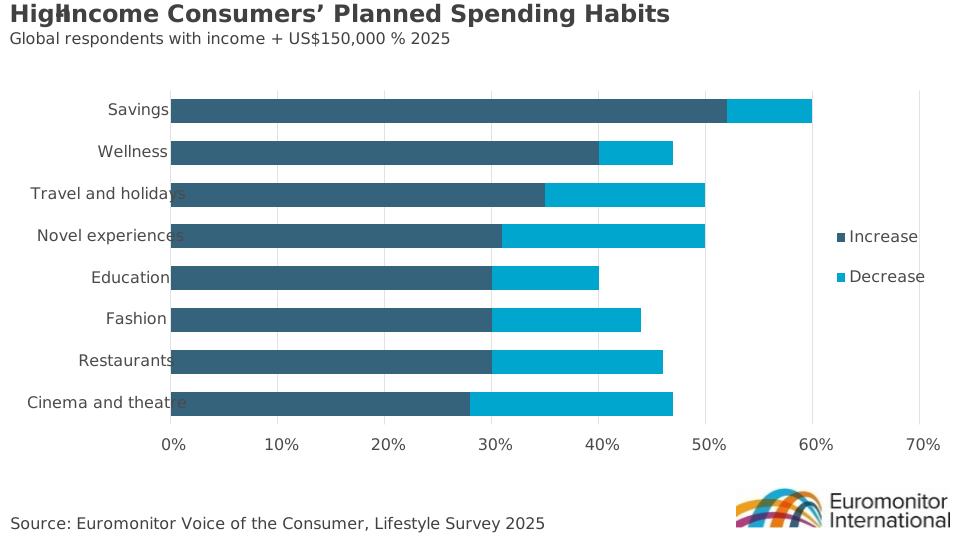
Economic resilience and greater short-term policy certainty will support consumption growth in luxury and fashion for 2026. Nevertheless, below-potential expansion in many markets and lingering geopolitical risks mean that building operational efficiency and agility remain critical. Success in 2026 hinges on a clear dichotomy, that requires a dual approach: optimising operations in mature markets, while scaling presence in dynamic emerging economies to capture outsized growth and new consumer cohorts.
Opportunities that luxury and fashion brands should prepare for:
- Tech acceleration: AI-driven personalisation and immersive digital experiences
- Climate accountability: Sustainability as a non-negotiable
- Global rebalancing: Emerging markets and new demographics as growth engines
- Experience economy: Emotional loyalty over transactional relationships
- Wellness dominance: Health and lifestyle as luxury and fashion’s new frontier
Listen to our experts, Fflur Roberts (Global Insight Manager: Luxury Goods) and Marguerite LeRolland (Global Insight Manager: Fashion) discuss the key trends in luxury and fashion in 2026, and strategies to build growth and resilience in our video.