
2025 was a particularly challenging year for restaurant owners from both an operations and business perspective. An uncertain economic landscape complicated by ongoing US trade policy reforms is impacting consumer foodservice. Of particular concern in 2026 are increased immigration and customs enforcement (ICE) activity, and national guard deployments. While immigration reform has been disrupting upstream workers’ lives, affecting labour and supply availability, intensified ICE enforcement has created deeper uncertainty. This has led to a documented reduction of movement in targeted communities, where individuals – regardless of legal status – have avoided public spaces and workplaces during active operations. Affected local markets have seen drops in reservation traffic of more than 20%, as well as drops in tourism, leading to outlet closures amidst an already difficult year.
Consumer foodservice struggles in tough 2025
Following a half decade of recovery and growth from the COVID-19 pandemic lows, the US consumer foodservice industry’s growth has begun to plateau, as the market settles after its previous disruptions.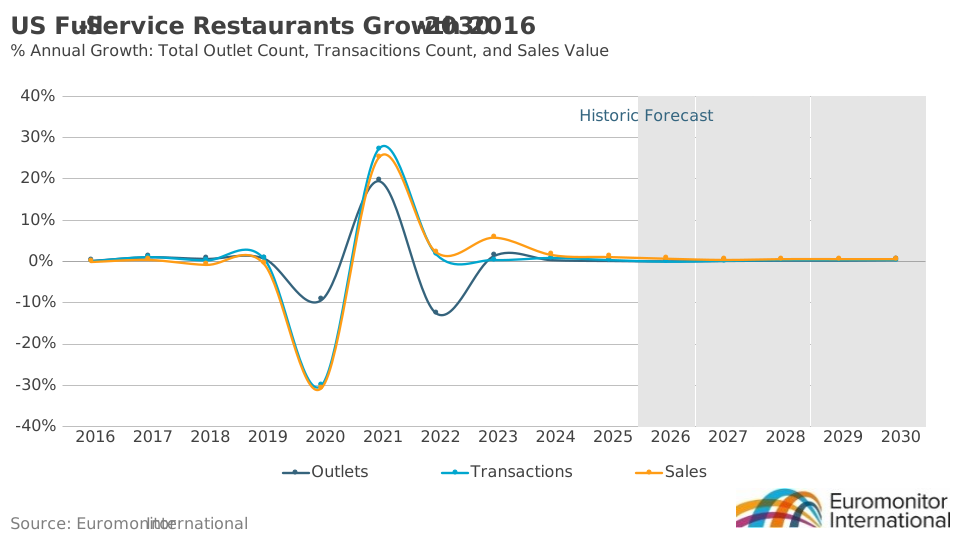
Continuing high inflation, the impact of tariffs on food prices, labour constraints, and a year of low disposable income for consumers have combined to test the resilience of foodservice operators nationwide. Foodservice traffic has generally been flat, while prices and thus sales value have risen over the last year.
Three consecutive years of minimal transaction growth recorded in the foodservice industry between 2023 and 2025, while value sales growth in real terms slowed from 5.8% to 1.1%
Source: Euromonitor International
This follows the increasing frequency of repressive government interventions in 2025. ICE disclosures reveal that 29 individuals died in custody through December 12 - the highest number since the 2004 peak of 32 – creating a new level of instability for owners, employees and consumers.
Immigration enforcement operations create dual pressure on labour supply and customer demand
The foodservice industry’s reliance on an immigrant labour force (both documented and undocumented) to staff restaurants and provide an upstream supply of ingredients has turned restaurants and surrounding neighbourhoods into flashpoints. Many employees and consumers, in response, are reluctant to participate in restaurant consumption on either end of the transaction. Following the National Guard deployment in Washington DC, the capital saw a 24% drop in reservations from OpenTable in the week of 11 August 2025, with week-to-week reservations data remaining mostly negative for the remainder of the year. As a result, Restaurant Association Metropolitan Washington counted 92 local restaurant closures by year end, along with an estimated 5.1% drop in tourism, according to Washington DC’s economic development organisation Destination DC. Among full-service independents, Euromonitor International projects declining transactions and miniscule growth (0.3%) in outlets in 2026. Additional impact from ICE operations is currently affecting operators during lean months, which could exacerbate this decline.
Following enforcement operations in Chicago in September 2025, restaurant and retail activity has also slowed. This drop is most salient in targeted neighbourhoods like Chicago’s Little Village, but even outside of these areas, the city is filled with independent operators such as Marcos Carbajal and Esam Hani, which, according to news sources, have reported sales drops as large as 40%, in addition to difficulties with staff attendance because of apprehension brought on by ICE activity.
The “largest immigration operation ever”, according to ICE, is now ongoing in Minneapolis and North Carolina, with stated intent for operations in Portland, California, New York and more to follow within the year. If a similar pattern follows in all these locations, 2026 will be another difficult year for restaurant operators, which have not had time to stabilise following the impact of COVID-19. Even the chained sector of full-service is projected by Euromonitor to see declining outlet counts and transactions in 2026, with consolidation and bankruptcies early in the year. Further disruptions will, again, complicate an already bleak outlook for the industry.
Independent operators and consumer demand face heightened pressure in 2026
Independent operators will undoubtedly feel a greater impact than chained foodservice, where operators are more able to absorb the blow to labour, and have more power to negotiate with suppliers, even as tariffs continue to inflate the cost of ingredients.
Consumer demand is also under pressure. Around one fifth of US respondents in Euromonitor International’s Voice of the Consumer: Lifestyles survey indicated a slower rate of visiting restaurants in 2025, but notably, the Hispanic or Latino group saw a doubling of the proportion of respondents intending to decrease the number of visits to restaurants over 2023-2025.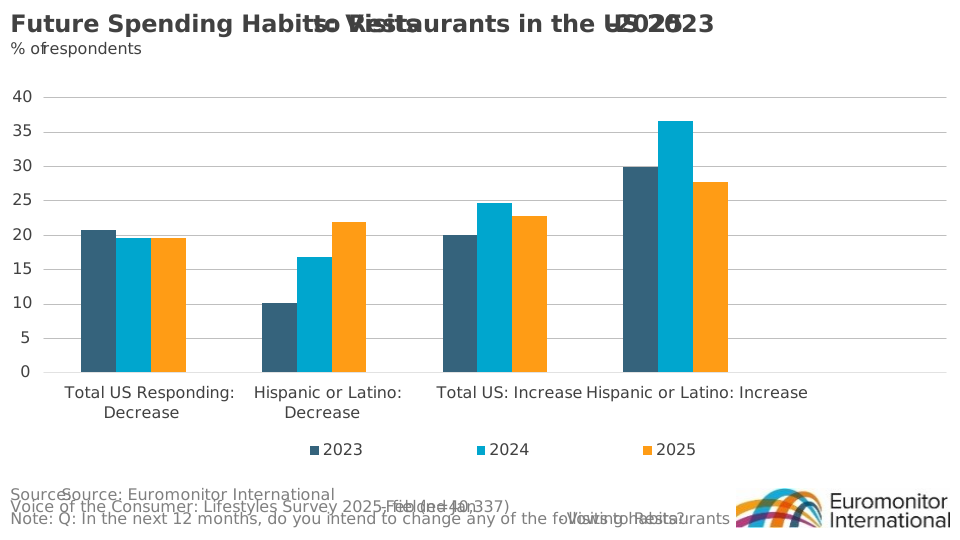
In just one example, local organisers in the Belmont-Cragin neighbourhood of Chicago pulled together a series of “Taste of Belmont-Cragin” events in 2025 to direct visits and spending from across the city to outlets which might have otherwise shuttered indefinitely, due to the disproportionate impact on Latino business owners. Repeatedly now, the community has shown a habit of noticing and supporting operators which intentionally align with their values. Some operators have shifted fulfilment strategy to protect workers and themselves, temporarily shuttering secondary locations, moving to a pick-up only strategy, and hiring watchmen to balance safety with keeping the outlet and employees afloat. Survival will require adaptability, but even the most resilient can only continue with a makeshift operation for so long.
Discover more on disruptors, drivers, developments and the overall state of the US foodservice industry read our briefing, Consumer Foodservice in the US.