
As increasingly digital consumers prioritise convenience in their purchasing decisions, online delivery’s share of restaurant sales has skyrocketed. With third-party delivery fulfilment being the biggest engine for growth, foodservice operators are seeing their margins eroded by merchant fees. Thriving, let alone surviving, is a juggling act when ingredient, shipping, and labour costs continue to rise.
Six years after COVID-19’s proliferation, eat-in occasions are struggling to recover
While global limited-service restaurants were able to return to their pre-pandemic foodservice sales by 2021, full-service figures only recovered in 2025. Looking ahead, conditions remain difficult for dine-in. Consumer confidence is weak, geopolitical tensions are pushing up commodity prices, and a larger climate of fear is testing the resilience of away-from-home occasions. Out of the crucible of isolation, one of the industry’s most significant structural changes has been the ongoing consumer shift to online delivery.
Delivery represented only 7% of global foodservice sales in 2019, but, even after an easing of lockdown restrictions, online delivery now accounts for 20% of global foodservice sales
Source: Euromonitor International
The stickiness of this trend can best be attributed to the increasing spending power of digitally native demographics who prioritise convenience.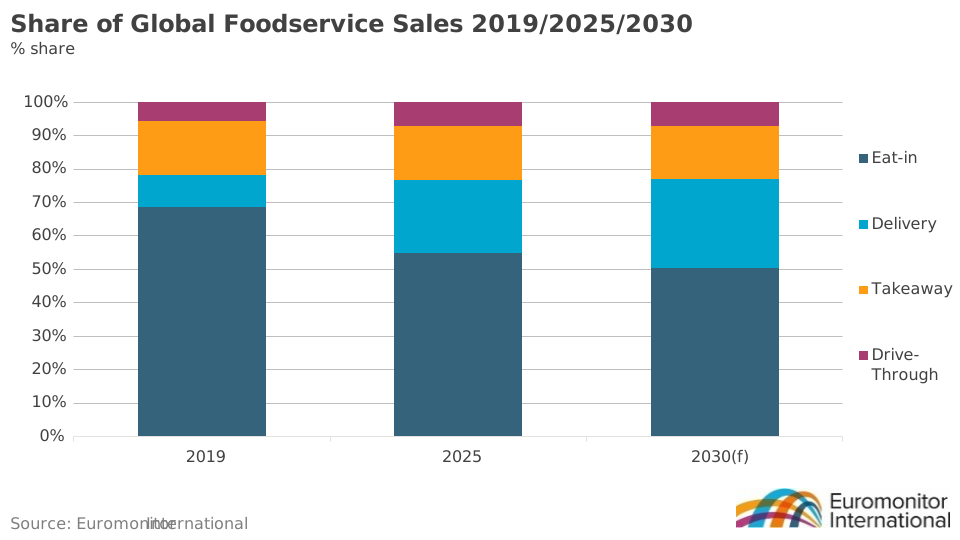
Foodservice operators must emphasise experience in their value proposition
In the Euromonitor Voice of the Consumer: Lifestyles Survey, fielded January-February 2026 (n=39,949), 21.5% of global consumers intend to increase their visits to restaurants in the next 12 months, a slight decline from the 22.4% who answered the same question fielded January-February 2025 (n=40,031). When segmenting by income, consumers surveyed in 2026 earning more than USD80,000 (n=4,642) contributed significantly to this sentiment, with 27.4% voicing intent to increase restaurant visits in the coming year. Two of the most critical product attributes driving premiumisation have been wellness and experience. While nutrition‑forward menu innovation has been the immediate strategy to capture wellness-minded consumers, these all face substitution threats from packaged food and beverages or margin threats from third-party delivery fulfilment. For sustained success, operators need to go beyond menu tweaks and create compelling, authentic, and distinctive on‑premise experiences. In a market environment where consumer motivations can diverge sharply depending on income, restaurants will need to choose between the more competitive but accessible field of affordable convenience and the high‑risk/high-reward space of in-person premium dining. The path forward will depend on building environments that offer genuine connection and differentiation, both elements that cannot be replicated through delivery or digital ordering alone.
A holistic view of consumer needs is necessary to cement brand equity
In markets where discretionary spending is being stretched, consumers are becoming more discerning in their purchasing decisions. The threat of category commoditisation, particularly in food and beverages, and a larger consumer shift towards outcome‑focused decision‑making are transforming FMCG strategies. “Need states” – a complex and diverse set of criteria consumers seek to induce an emotional and/or physical outcome – rethinks product development and marketing, expanding beyond moment‑specific consumption benefits to encompass identity, mindset and longer‑term personal goals. As a result, positioning to meet a desired physical or mental condition, such as escape, calm or optimisation, can be as influential as its formulation. This trend is not entirely new; brand slogans have long aimed to trigger emotional responses. What is changing is the competitive logic behind these messages. Instead of differentiating primarily on category attributes, brands are repositioning themselves around specific, sought‑after outcomes. Identifying “white space” now means pinpointing unmet emotional or functional goals and designing products and messaging that directly signal their ability to deliver them.
By marrying format, ingredients and storytelling to these deeper motivations, brands can establish more resonant value propositions. This approach has helped FMCG players move beyond transactional benefit claims and build stronger, longer‑lasting connections with consumers seeking products that support their broader aspirations. Foodservice operators can certainly take cues from this approach to signal a premium value, but the upper hand lies in their unique experiential attributes. By understanding how your outlet space and hospitality strategy can address a broader consumer need state, you can truly incentivise consumers to meet you where you’re at.
Download our new white paper, In Real Life: The Unique Lure of Physical Experience, for in-depth trend descriptions, case studies and strategic recommendations.