

As the Iran war brings economic disruption to global consumer markets, Euromonitor looks back at previous crises – the 2008 global financial crisis, the COVID-19 pandemic and the war in Ukraine to understand how each of these crises changed consumer markets.
In 2026, travel faces its worst operational disruption since the pandemic, while food producers grapple with transport-driven inflation and shortages of key inputs, such as fertilisers and CO2. Learning from previous crises, companies will need to strategically absorb some rising costs instead of burdening crisis-weary consumers, recognising that consumers will place increased value primarily on price but also on trust, authenticity and locality. Those companies that recognise and respond to crisis-influenced behaviours will be best equipped to navigate the impact of the Iran war.
Entering fourth major disruption to consumer markets in nearly 20 years
The 2026 US/Israel-Iran war marks the fourth major economic disruption to global consumer markets in under two decades. While each crisis originated differently, their impacts on consumer markets and behaviour reveal distinct patterns that are vital for strategic planning. And, while each crisis has unique characteristics, common patterns emerge: consumers shift towards value during income squeezes, supply chain resilience becomes paramount, and companies with diversified portfolios and flexible pricing strategies navigate better than their competitors.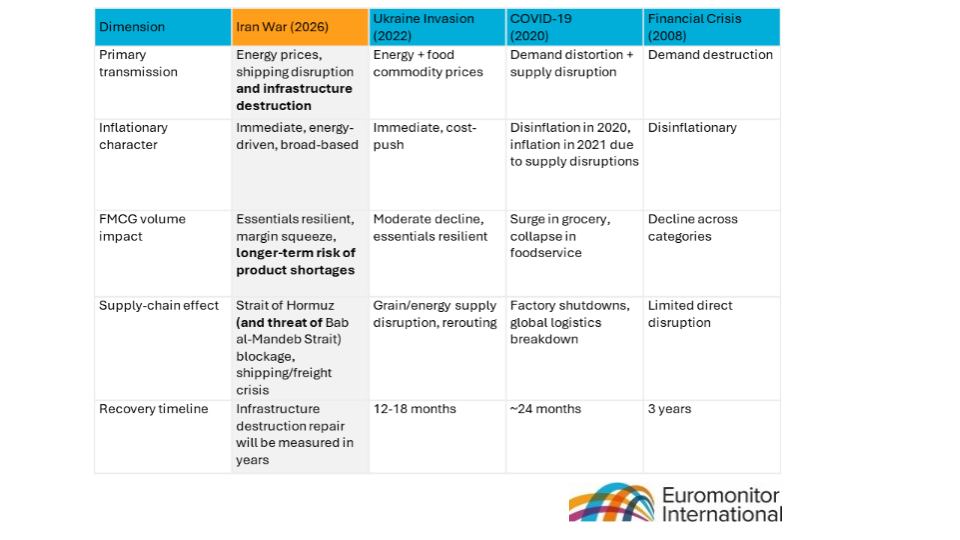
The financial crisis of 2008 began in advanced economies and spread globally through financial channels. A defining trend was the reversal from "trading up" to "trading down" seen across all regions. In beauty and fashion, shoppers migrated from premium to mass or "masstige" brands. Retail growth of premium beauty and personal care more than halved to just 2% in current value terms in 2008 as consumers switched to mass or "masstige" brands. Following the 2008 crisis, global retail spending required three years to recover.
COVID-19: Digital acceleration and wellness as prevention
The COVID-19 pandemic caused unprecedented disruption to fast-moving consumer goods (FMCG) sales due to immediate stockpiling, fundamental shifts in consumption patterns towards at-home, larger pack sizes, and expansion of e-commerce. Global sales of home-cooking categories thrived, with meal kits surging 50%, and staple foods growing 7% in current value terms in 2020.
A legacy of the crisis was speed of digital acceleration. Global e-commerce sales of packaged food skyrocketed, establishing online grocery and direct-to-consumer (DTC) models as permanent baseline retail channels. At the same time, consumer priorities were redefined towards “wellness as prevention”, with a heightened focus on immune-boosting functional foods and products supporting mental wellbeing.
Ukraine 2022: The energy tax on consumption
Russia's invasion of Ukraine in 2022 disrupted FMCG supply chains and consumer spending. The war came on the back of a global economy still recovering from the effects of COVID-19. It accelerated energy and commodity prices, creating “stagflation” – high inflation with stagnating economic growth. Rising prices squeezed consumers while low wage growth dampened confidence. Food categories experienced severe impacts, particularly edible oils and grain-dependent products. Consumers increased private label purchases, with the UK private label share of dried pasta growing 4.3 percentage points in 2022, whilst “shrinkflation” emerged as a widespread strategy.
Necessity of supply chain resilience and flexible portfolios
Critical strategies seen in previous crises have included dynamic pricing and adjustments to pack price architecture. Companies have protected profitability through selective price adjustments, introducing smaller, higher-margin pack sizes ("shrinkflation") and creating hybrid products – such as cosmetics with skin care features – to justify price points. Brands with diversified offerings across premium, mid-market, and value segments have demonstrated greater stability, as consumer priorities polarise between value and quality. Equally, businesses that rapidly pivoted to digital and value-driven strategies were better placed to weather the crises. During COVID-19, Shiseido recovered from declining sales by transitioning to e-commerce, Chinese dairy firms adopted direct delivery via WeChat, while Amazon expanded its workforce by 100,000 to address heightened online demand.
Strategic considerations for the Iran war
Contrary to earlier crises, the current war is causing a sustained cost squeeze across energy and shipping, exacerbating ongoing post-pandemic supply chain strains. And it is doing so on a consumer base weary from previous shocks. At a time when the average household in 2025 spent 33% more on all goods and services compared to before the pandemic, food producers are encountering heightened inflationary pressures from transport costs.
Building on learnings from previous crises, companies need to be prepared not to pass on all costs to consumers, battered as they are by consecutive crises, meaning some margin loss will be expected, with huge pressure on middle-tier products. From the consumers’ side, consumers will value trust, authenticity and locality as, aside from necessities, they will value spiritual health and community (including family) as home becomes the mainstay again. In terms of supply, reliance moves from near-shoring to explicit friend-shoring/ally-shoring and companies will need to factor in the cost of warehousing reserves and time for infrastructure repair in the GCC region.
Looking ahead, the dominant trend is the institutionalisation of crisis-related behaviours – emphasising localism, value, supply chain reconfiguration, and wellness – as consistent elements of consumer behaviour. Organisations should surpass mere cost optimisation by investing in diverse sourcing, regional manufacturing, and by making trust, authenticity, and community engagement foundational to their value proposition.
For additional analysis, refer to the full report, Building Market Resilience: Applying Crisis Learnings to the Iran War.
This article was developed with AI assistance. All content originates from Euromonitor’s report, Building Market Resilience: Applying Crisis Learnings to the Iran War, and has been reviewed to ensure adherence to quality and accuracy standards.