
The US economy has endured years of rising costs, and 2025 brought renewed uncertainty as geopolitical risks and market volatility disrupted recovery. Trade agreements and tariff adjustments with partners like China have offered some relief, but instability has eroded business confidence and weakened consumer sentiment – especially in discretionary categories such as apparel and footwear. While spending continues, consumer behaviour has shifted sharply: heightened price sensitivity, value-driven choices, reduced brand loyalty, and cautious purchasing now dominate. These trends signal a fundamental transformation in how businesses and consumers navigate uncertainty.
Businesses and consumers push back against rising tariffs
The US apparel and footwear market is heavily reliant on imports – approximately 78% of apparel and 75% of footwear sold in the US are imported. Most production is concentrated in Asia, with China as the leading partner, accounting for 21% of apparel imports and 36% of footwear imports in 2024. This dependency makes the supply chain highly sensitive to geopolitical factors. Recent tariffs and escalating US-China tensions have significantly disrupted sourcing strategies, impacting both business performance and consumer behaviour.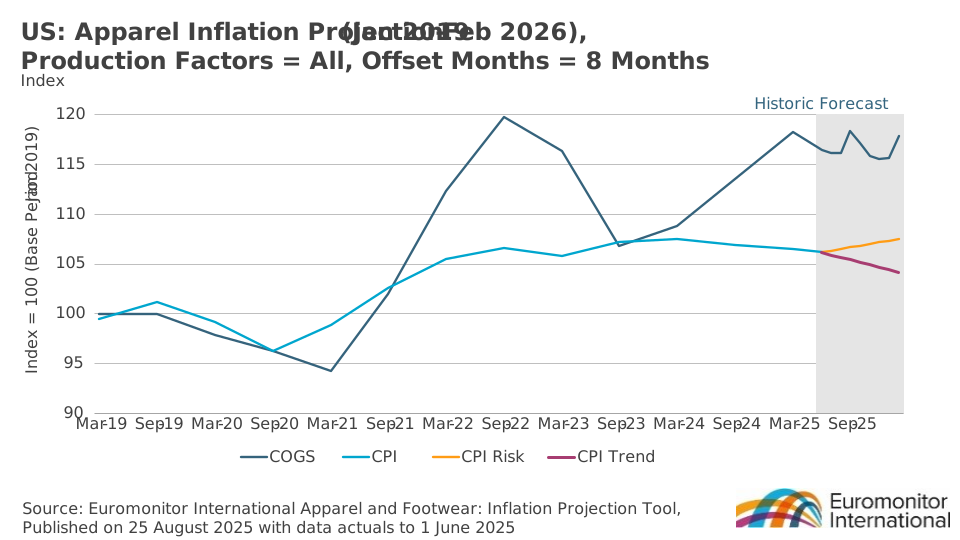
In the post-pandemic era, the cost of goods sold (COGS) of apparel and footwear followed an upward trajectory, peaking in mid-2022 before easing in 2023. However, costs have risen again in 2025, driven by renewed tariff pressures. While these increases were not fully passed on to consumers, CPI for apparel and footwear surged in 2021, fuelled by a strong economic recovery and higher disposable income that supported spending on premium and luxury items. Since 2022, CPI has remained relatively flat – and even declined slightly in 2025 compared to 2024 – despite rising input costs. This trend reflects two key dynamics: retailers absorbing cost increases to maintain demand, and consumers trading down to lower-priced options amid economic uncertainty and declining confidence.
Market moves from recovery to retrenchment under pressure
Since 2022, rising living costs have made US consumers increasingly cautious about discretionary spending, including on apparel and footwear. As a result, market growth slowed significantly. In 2024, the sector showed signs of recovery, supported by easing inflation and a more stable economic environment, delivering growth in both volume and value.
Had 2025 maintained that stability, the market could have returned to its normal growth trajectory with higher year-over-year gains than in 2024. Instead, persistent economic uncertainty reshaped consumer behaviour.
While shoppers continue to buy apparel and footwear, many are trading down to lower-priced options or turning to the second-hand market, limiting primary market growth to below 1% in current value terms in 2025
Source: Euromonitor International
Businesses, still in “wait and see” mode, have avoided significant price hikes, leaving consumers room to adjust. However, 2026 may present tougher conditions: fewer trading-down options and inflation-driven nominal growth of 2.5%, which translates to a 0.3% decline in real terms. This signals mounting challenges for both businesses and consumers to adapt – or risk losing ground.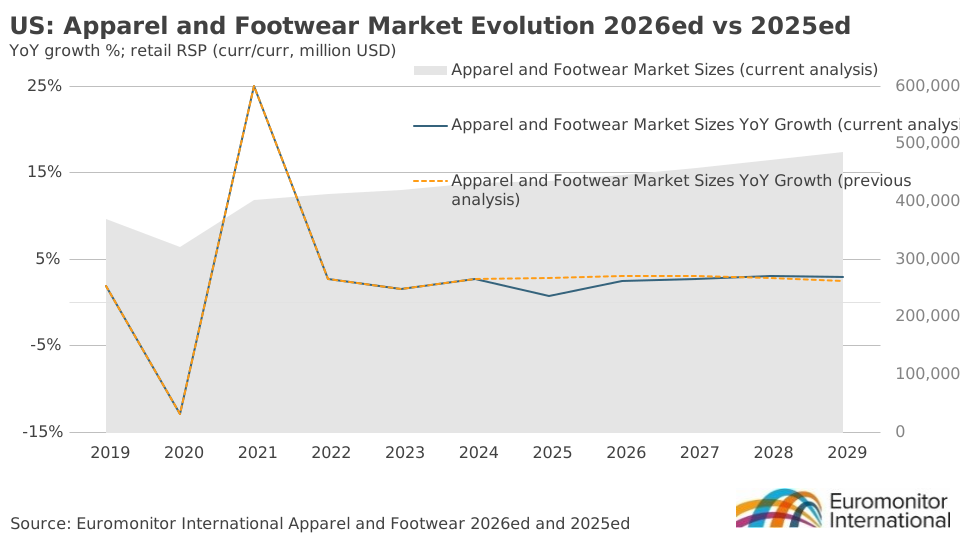
Selective spending and shifting brand loyalty reshape the market
Under persistent economic uncertainty, US consumers have become increasingly selective in their apparel and footwear purchases, seeking maximum value – not just in price, but in functionality, fashion, and versatility. Instead of buying head-to-toe from one or two favourite brands, shoppers are waiting for promotions and mixing pieces from different labels to create their style. This shift has led to declining brand loyalty and intensified competition.
According to Euromonitor’s Voice of the Consumer: Lifestyles Survey (fielded January-February 2025), only 19% of US respondents cited “strong or well-known brand” as an influential factor in apparel and footwear purchases, down from 21% in 2024. This erosion of loyalty has opened the door for challengers – brands that combine unique strengths with competitive pricing.
Among the fastest-growing players in 2025 were Aritzia, On, and Uniqlo, each delivering 20-25% growth, driven by their ability to offer distinct value propositions. Some incumbents are responding strategically, forging partnerships with rising brands to broaden reach and leverage combined strengths. For example, in October 2025, Nike launched a trainer collaboration with Aritzia, signalling a new era of collaborative competitiveness in the US market.
As US apparel and footwear faces mounting challenges and shifting consumer dynamics, opportunities for growth remain – but only for those that react faster and more strategically. The world’s largest apparel and footwear market is evolving, and success will depend on adaptability, innovation, and a keen understanding of the new consumer mindset.
Explore the impact of shifting macroeconomic dynamics in our articles, Market Volatility: Challenges and Opportunities for the Fashion Industry and Trending Topics: Market Volatility.