
From 10th to 21st November, global leaders will gather in Belém for COP30 – a pivotal moment not just for climate diplomacy, but for business strategy. For FMCG companies, this isn’t just another summit. It’s a signal: environmental risks are now board-level priorities. Droughts, deforestation, and water stress are disrupting supply chains. Consumers are demanding transparency. Investors are watching. The time to act is now.
In 2025, businesses feeling pressure from boards to act on climate change surged to 71%, up from 64% in 2024
Source: Euromonitor Voice of the Industry Survey, fielded April 2025 (n=258) and April 2024 (n=499)
This article shares some insights from our Global Sustainability Trends: Embracing a Lower Carbon Future report, revealing how leading companies are turning sustainability into a lever for resilience, innovation, and growth.
Strategy must lead execution
Execution is outpacing strategy. While 62% of companies plan sustainable product launches, only 53% have a net-zero strategy. Just 6% believe they communicate sustainability effectively to consumers.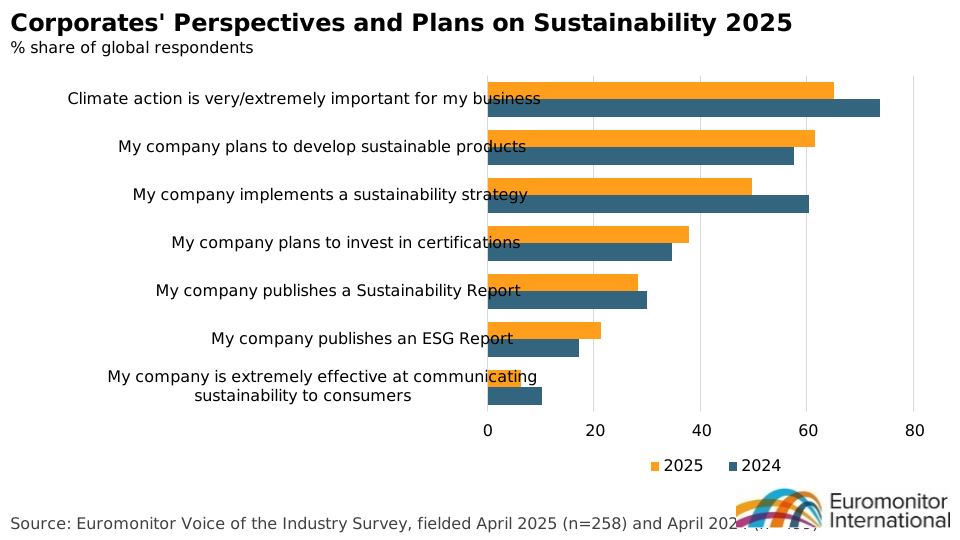
- Embed sustainability into enterprise risk frameworks;
- Align product innovation with verified claims;
- Tailor communication for regulators, investors, and consumers.
Sustainability leadership isn’t about isolated initiatives – it’s about integration across the business.
Climate action is accelerating – but emissions still climb
Despite growing momentum, global greenhouse gas (GHG) emissions are projected to rise by 0.4% annually through to 2029.
The challenge is systemic – but progress is real:
- Emissions intensity dropped by 2.3% annually (2019-2024);
- One in four companies are investing in low-carbon product innovation;
- 34% plan to launch products with carbon-neutral or reduced-carbon claims.
Brands like Strong Roots and Neutral Foods are leveraging verified carbon data to build trust and stand out in saturated markets. The takeaway? Carbon transparency is becoming a competitive edge.
Waste is fuelling innovation
Waste contributes 3.3% of global GHG emissions. In Europe, recycling is outpacing waste generation, and landfill use is declining – a clear shift towards circularity.
FMCG companies are responding decisively:
- 67% plan to invest in waste and recycling;
- 72% are prioritising sustainable packaging claims;
- rPET (recycled PET) claims grew by 23% annually, led by soft drinks.
Innovations like Dr Beckmann’s microplastic-free cleaning sheets and Vetain’s recyclable paper packaging show how circular design can reduce emissions and cut costs. Waste isn’t just a problem – it’s a platform for innovation.
Water stewardship is gaining urgency
Water stress is intensifying, especially in agriculture-heavy regions like Asia Pacific and Latin America. With over 80% of water withdrawals linked to farming, FMCG firms must evolve from efficiency to regeneration.
Smart strategies are emerging:
- PepsiCo reuses 70% of treated water, saving over USD2 million annually;
- Kao’s Eco Together label certifies 20% water savings, supported by consumer education;
- L’Oréal and Unilever are piloting basin-level restoration and rainwater harvesting.
In categories like beauty and home care – where most water use happens post-purchase – brands must connect sustainability with convenience and performance.
Nature is a strategic asset
Nature loss is accelerating. Over 62,000 species are now threatened – double the number in 2015. Agricultural and forest land per capita is shrinking, while demand in sourcing hotspots continues to rise.
Organic farming alone won’t close the gap. Regenerative agriculture is gaining traction:
- Nescafé sources 32% of its coffee from regenerative farms, surpassing its 2025 goal;
- 61% of companies plan to invest in sustainable sourcing;
- Certifications like Fairtrade and Rainforest Alliance are becoming standard.
Nature-positive sourcing is no longer a nice-to-have – it’s essential for supply chain security and brand resilience.
Sustainability is no longer optional – it’s the foundation of resilient growth. As COP30 approaches, the message is clear: companies must align strategy, execution, and communication to lead the low-carbon transition.
Learn more about our Sustainability expertise and capabilities by reading our Global Sustainability Trends: Embracing a Lower Carbon Future report, watch our recent What’s in the basket? Unpacking which sustainability claims drive consumer purchases across Europe webinar, and visit our Sustainability page for further insights into where to play and how to win with sustainable claims.