SustainabilityOur global experts keep pace with sustainability trends providing timely insights on shifting consumer preferences and the latest innovations, strategies and investments shaping governments and business agendas.
B Corp certification occupies a distinct position in the sustainability claims landscape as a company-level governance framework. Yet, as more brands communicate B Corp status on-pack and across digital shelves, it increasingly functions as a consumer-facing signal – one that is both expanding in reach and coming under greater scrutiny.
Rather than promising a specific environmental outcome, B Corp signals something broader: that social and environmental responsibility is embedded into how a company is governed, not just how a product is made. Its growing visibility across FMCG therefore raises a central question: what does B Corp actually signal at scale?
Where B Corp shows up – and why
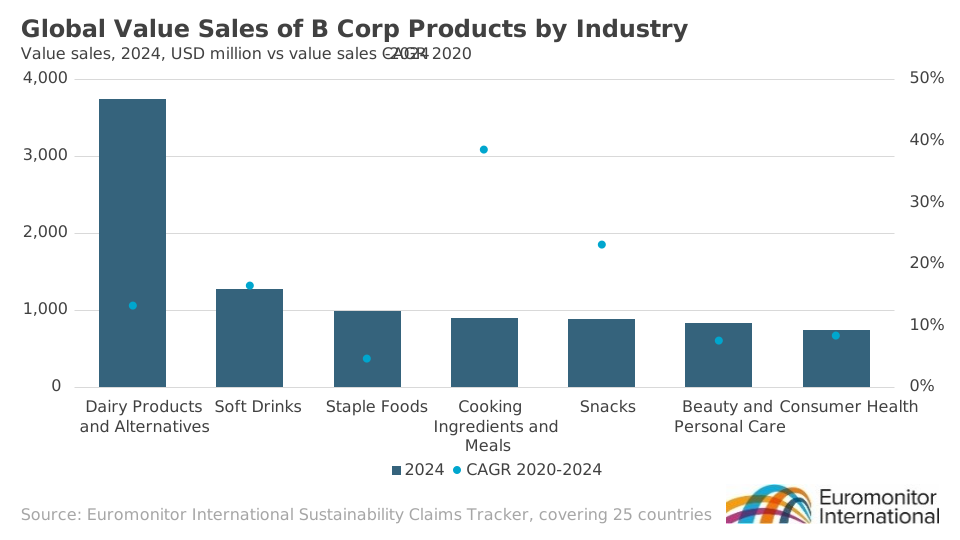
Euromonitor International’s Sustainability Claims Tracker shows that, in 2024, dairy accounted for the largest share of global value sales of products communicating B Corp, followed by soft drinks and staple foods. These categories combine high consumer sensitivity to sustainability issues with manufacturers capable of implementing certification across complex value chains.
Dairy’s prominence reflects both category exposure and organisational capacity. Environmental pressure points – from methane emissions to animal welfare – are highly visible. Euromonitor International data shows that Danone has been the leading company by value sales of B Corp-communicating products in both dairy and soft drinks over the past five years. This sustained leadership highlights a key dynamic: B Corp rewards consistency more than selectivity. Portfolio-wide integration carries more signalling power than isolated product certifications do.
When certification scales – and when it fractures
If food and beverages show where B Corp can scale, personal care reveals where the certification is being stress-tested.
Beauty and personal care was among the earliest adopters of B Corp, home to brands that helped define the certification’s original ethos. Companies such as Weleda and Tom’s of Maine remain leading examples of “built-in” B Corps, where social and environmental responsibility is embedded into core business models.
Yet, the data suggests a category in reassessment.
The number of beauty and personal care online SKUs communicating B Corp globally declined by more than 6,000 between Q3 2023 and Q3 2025 – a sharper contraction than in any other industry
High-profile exits reinforce this tension. The decision by Dr Bronner’s not to renew its B Corp certification in 2025 was framed not as a rejection of sustainability, but as a critique of the certification’s evolution. The company argued that expanding participation had weakened standards, particularly around supply chain accountability.
B Corp’s challenge has shifted: the issue is no longer adoption, but differentiation.
Growth driven by governance fit
At the same time, the fastest-growing B Corp-communicating categories are those where governance can actively structure business models. Cooking ingredients and meals is the fastest-growing segment by value sales, driven by a small number of influential brands such as Gousto and Charlie Bigham’s in Western Europe.
Here, B Corp functions less as a symbolic signal and more as an organising framework, shaping sourcing, labour practices and decision-making in premium, convenience-led food systems. Staple foods show a similar pattern. Brands such as Tilda demonstrate that governance-led certification can gain traction even in low-margin categories like rice when it aligns with long-term operational discipline.
From badge to baseline
The most consequential milestone came in 2025, when Danone became the first top 10 global FMCG company to achieve B Corp certification. The significance lies not only in scale, but in spillover effects. By requiring Tier 1 suppliers to align with B Corp principles, Danone extends governance expectations beyond its own operations – a critical lever in sectors where Scope 3 emissions dominate environmental impact.
Between 2020 and 2024, Danone reports a 16% reduction in CO2e emissions, a 25% reduction in methane emissions from milk production, and packaging that is now 85% reuseable, recyclable or compostable. Yet, its certification does not settle the broader debate surrounding B Corp. As participation expands, the challenge mirrors that faced by other third party standards.
In Every Purchase Matters, Paul Rice reflects on the difficulty of balancing rigorous standards with the ambition to influence large buyers. For companies and consumers alike, B Corp is best understood not as a badge of excellence, but as a baseline for accountability – embedding governance, transparency and continuous improvement into business structures as sustainability claims mature.