
In the CPG competitive landscape, product claims have long been viewed as a strategic tool for differentiation and premium pricing. Health-focused claims have historically commanded price premiums as consumers demonstrate willingness to pay more for perceived nutritional benefits. However, an analysis of RTE cereals in the US reveals a counterintuitive phenomenon: When a product claim reaches market saturation, it ceases to function as a price differentiator and, instead, becomes a baseline requirement for category participation. This transformation fundamentally alters the pricing dynamics, effectively neutralising any premium potential the claim once held.
The saturation point: Protein claims in cereal
The data from 331 RTE cereal SKUs in the US during 1 April to 1 October 2025, with selection criteria of 340g net weight, single pack and no bundles of leading brands, illustrates this dynamic with striking clarity.
An overwhelming 66% of cereals (219 SKUs) now feature protein claims, leaving only 112 products without such messaging
Source: Euromonitor International
This distribution alone signals that protein claims have transcended their original role as a specialised positioning strategy and evolved into an industry-wide standard. When such prevalent adoption happens with the same claim, it no longer distinguishes products from one another – it simply meets consumer expectation that has become universal.
The price inversion
What makes this case particularly compelling is not just the prevalence of protein claims, but the pricing pattern that accompanies it. Contrary to conventional wisdom about health claims commanding premiums, cereals with protein claims trade at lower average prices across all price points compared to those without such claims.
Cereals without protein claims show an average lowest price of USD8.96, a median price of USD9.59, and a highest price of USD10.27. Meanwhile, cereals with protein claims demonstrate considerably lower pricing: USD6.28 for the lowest price point, USD6.93 for median, and USD7.29 for highest. This represents approximately a 30% price difference across the board – with the products making the health claim selling for less, not more. Moreover, as shown by the chart below, products without protein claims enjoy much higher mark-ups.
This pricing pattern reflects a fundamental shift in how protein claims function within cereals. When the claim was novel and adopted by few products, it created genuine differentiation. Early adopters positioned themselves as innovative, health-forward options and justified premium pricing. Consumers seeking that specific benefit had limited choices and were more likely to accept higher prices to access products that met their needs.
Looking at Euromonitor’s Innovation data, out of RTE cereal product launches over the past few years, the number of launches that claim “high protein” as a marketing claim grows yearly in the US. Out of 102 product launches with this claim, 38 are from 2025, while only seven are from 2021. As the next chart shows, growth of this claim has been exponential in recent years. Moreover, out of all the product launches with this claim, 80% have remained on shelves, versus 62% of all products launched in the category since 2021, showing the staying power of a “table stakes” claim.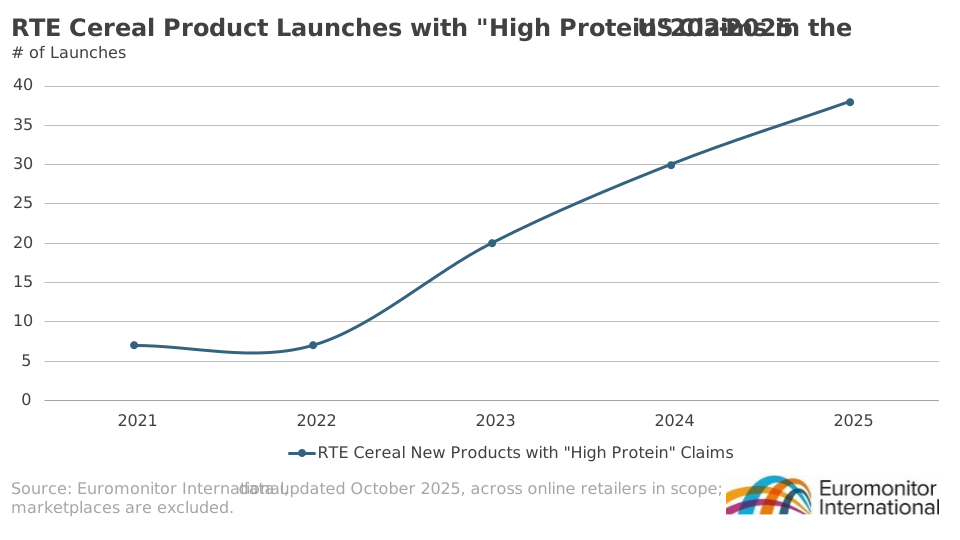
From premium to commodity, the story of adoption
RTE cereals’ experience with protein claims demonstrates that claim proliferation follows a predictable lifecycle: innovation, adoption, saturation and, ultimately, commoditisation. At the commoditisation stage, the claim no longer justifies premium pricing because it no longer provides meaningful differentiation, yet it is needed for shelf longevity. For product managers and marketers, this underscores the importance of monitoring claim adoption rates across categories. By the time a claim appears in the majority of products, manufacturers face a choice: adopt the claim to remain competitive on basic terms or find genuinely distinctive positioning elsewhere.
Contact us to see which new products and claims have been gaining ground in your category, and read our latest briefing, Decoding Innovation: Signals, Scale and Survival, on how monitoring product launches, market expansion, and longevity can transform innovation into a strategic advantage.